

Executive Summary
In 2026, regulatory scrutiny across mature European and newly licensed jurisdictions (including the UK, Malta, the Netherlands, and Brazil) has fundamentally shifted compliance from reactive dispute handling to mandatory proactive player protection. Implementing predictive responsible gaming ai allows operators to detect early signs of problem gambling, calculate real-time player risk scores, and automate frictionless affordability assessments before players suffer financial distress. By analyzing micro-behavioral telemetry—such as deposit velocity shifts, late-night wagering escalation, chasing losses across volatile game categories, and cancel-withdrawal frequencies—machine learning models achieve over 92% precision in identifying vulnerable cohorts. This guide details the data pipelines, ML feature engineering architectures, automated tier-based intervention protocols, and regulatory audit trails necessary to maintain total compliance without compromising the experience of recreational players.
Predictive Responsible Gaming: AI-Driven Affordability Checks & Player Risk Scoring for 2026
For years, Responsible Gaming (RG) departments operated as reactive back-office support functions. Manual reviews of self-exclusion requests, retrospective loss audits, and static deposit limit alerts were the standard toolkit. In 2026, this reactive posture represents an existential operational risk. Major regulatory authorities—such as the UKGC, MGA, KSA, and Brazil’s SPA—now enforce strict mandates requiring operators to identify at-risk behaviors in real time and execute proportionate, automated interventions. Meeting these statutory obligations without destroying player conversion and lifetime value requires deploying predictive responsible gaming ai. Advanced game studios like DYG Games now integrate behavioral telemetry hooks directly into their RGS endpoints, enabling operators to analyze player decision streams with unprecedented granularity.
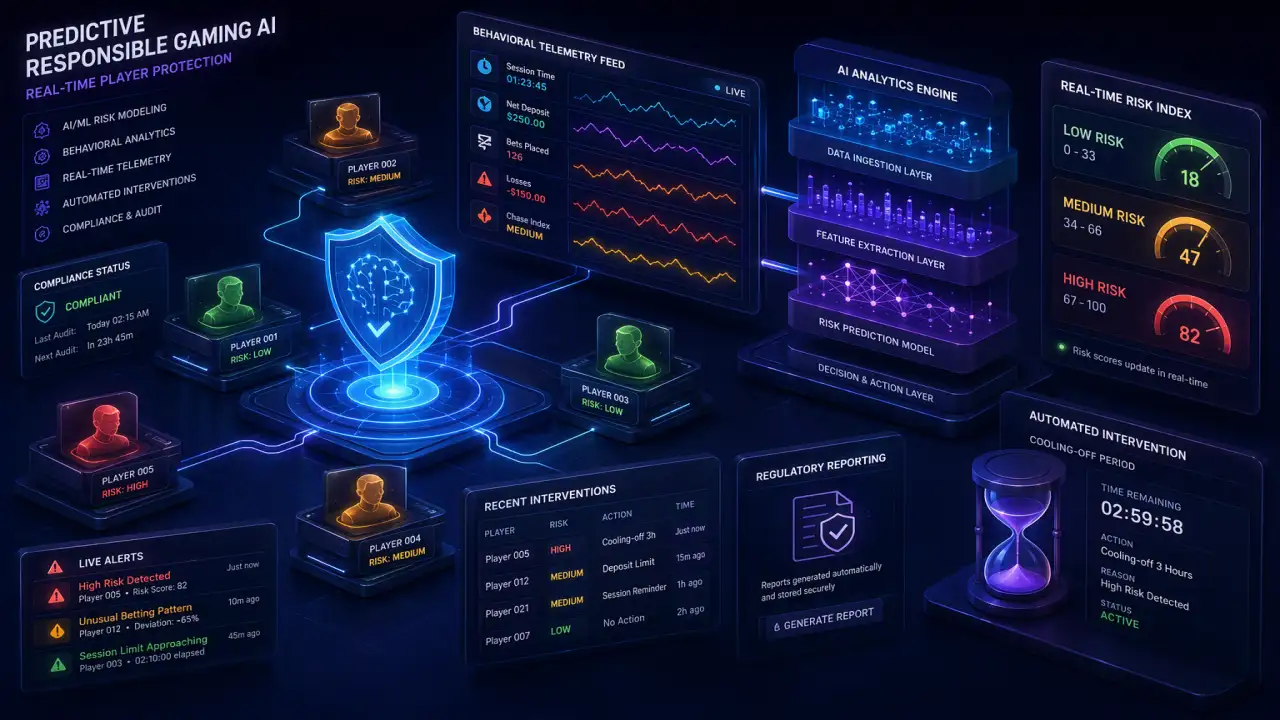
The Behavioral Signal Taxonomy: Feature Engineering for Problem Gambling Detection
Legacy RG systems relied on crude threshold triggers, such as “depositing more than €1,000 in 24 hours” or “playing for 4 consecutive hours.” These blunt heuristics suffered from high false-positive rates (flagging legitimate high-net-worth VIPs) while completely missing vulnerable low-stakes players exhibiting severe distress behaviors.
Modern machine learning models evaluate multi-dimensional behavioral vectors across five distinct signal clusters:
1. Transactional & Cashier Telemetry
- Deposit Velocity & Acceleration: Exponential increases in deposit frequency over rolling 1-hour, 6-hour, and 24-hour windows.
- Failed Transaction Churn: Repeated deposit attempts using multiple declined payment methods within minutes.
- Cancel-Withdrawal Frequency (Reverse Withdrawals): Reversing pending cash-outs to continue wagering, a primary psychological indicator of loss chasing.
2. Session & Time Dynamics
- Unusual Play Hours (Circadian Deviation): Sudden shifts to late-night (02:00–06:00) sessions diverging from a player’s established historical baseline.
- Session Lengthening & Velocity Creep: Accelerating spins-per-minute or switching from manual spins to high-speed turbo modes without pause.
3. Gameplay & Volatility Escalation
- Stake Tilting: Drastic, non-linear increases in bet sizing immediately following consecutive losing rounds.
- Volatility Hopping: Migrating abruptly from low-volatility casual games to high-volatility slots or extreme-multiplier crash games in an effort to recover net losses.
4. Account & Interaction Telemetry
- Cashier Page Visits without Depositing: Repeatedly opening and closing cashier screens, indicating cognitive conflict or funding desperation.
- Customer Support Sentiment Analysis: Natural language processing (NLP) applied to live chat transcripts detecting frustration, distress keywords, or demands for immediate bonus compensation.
| Behavioral Feature | Detection Window | Model Weight (SHAP Value) | Risk Correlation |
|---|---|---|---|
| Cancel-Withdrawal Count | Rolling 48 Hours | +0.28 (Very High) | Strongest predictor of acute loss of control |
| Deposit Frequency Acceleration | Rolling 6 Hours | +0.24 (High) | Indicates bankroll exhaustion and chasing |
| Stake Doubling After Losses | Active Session | +0.19 (High) | Martingale-style distress wagering |
| Circadian Shift (Nighttime Play) | Rolling 7 Days | +0.12 (Moderate) | Sleep disruption associated with compulsive habits |
| Live Chat Distress Sentiment | Real-Time NLP | +0.17 (High) | Direct verbal expression of emotional distress |
Machine Learning Model Architecture: The Risk Scoring Pipeline
Production predictive RG engines employ an ensemble model architecture combining Gradient Boosted Decision Trees (XGBoost / LightGBM) for tabular behavioral metrics with Recurrent Neural Networks (LSTM / Temporal Convolutional Networks) for sequential time-series session analysis.
1. Real-Time Telemetry Streaming
As gameplay events flow through Apache Kafka, a stateful stream worker continuously maintains rolling session features in Redis. The risk evaluation engine scores each active account at three discrete intervals:
- Event-Driven Triggers: Evaluated instantly upon high-risk events (deposit failure, withdrawal reversal, bet size surge >300%).
- Session Boundary Evaluation: Evaluated upon session termination or when active duration exceeds 60 minutes.
- Daily Batch Consolidation: Comprehensive overnight recalculation incorporating historical 30-day and 90-day macro trends.
2. The Continuous Risk Score ($R_{score}$)
The model outputs a normalized risk index from $0.00$ (Recreational / No Risk) to $1.00$ (Severe Problem Gambling Probability). This score dynamically categorizes the player into four actionable tiers:
| Risk Tier | Risk Index Range | Automated System Action | Operator Touchpoint |
|---|---|---|---|
| Tier 1: Green (Recreational) | 0.00 – 0.35 | Standard periodic reality checks (60 min) | None (Standard marketing enabled) |
| Tier 2: Amber (Emerging Risk) | 0.36 – 0.65 | In-game pop-up with session expenditure summary; suppress marketing push notifications | Automated educational email on RG tools |
| Tier 3: Orange (Moderate Risk) | 0.66 – 0.85 | Mandatory 15-minute cooling-off break; temporary deposit cap imposed; bonus lock | Assigned to RG compliance officer for manual review |
| Tier 4: Red (Severe Risk) | 0.86 – 1.00 | Immediate session freeze; automated deposit suspension; account locked pending review | Mandatory interaction by Senior RG specialist |
Automated & Frictionless Affordability Verification
One of the largest friction points in regulated markets is affordability checks. Demanding manual payslips, tax returns, and bank statements drives over 60% of legitimate players to abandon onboarding. In 2026, leading operators solve this through Open Banking API integration and automated credit-reference telemetry.
1. Open Banking Integration (PSD2 / Open Finance)
With player consent, the platform securely queries Open Banking APIs (such as TrueLayer, Tink, or Plaid) to extract real-time financial telemetry in under 5 seconds:
- Discretionary Income Calculation: Net monthly income minus essential fixed living costs (mortgage/rent, utilities, debt obligations).
- Dynamic Gambling Budget Cap: Automatically establishing a maximum monthly net loss ceiling (e.g., 10%–15% of discretionary income) without manual documentation review.
2. Socio-Demographic & Geo-Credit Proxy Modeling
In jurisdictions where Open Banking is unavailable, machine learning models estimate affordability bands using verified residential geo-demographics, credit bureau vulnerability indices, and public employment data. This provides a baseline risk threshold that flags out-of-profile expenditure before severe losses accumulate.
Integration Architecture: Game Studio Collaboration
Effective responsible gaming requires deep technical collaboration between the operator’s PAM and the content supplier’s game engine. Content provided by DYG Games’ certified casino portfolio supports native reality check APIs, mandatory spin interval enforcement (e.g., 2.5-second minimum spin timers in the UK), and zero-friction session freeze events pushed over WebSocket channels.
// Example RGS In-Game Reality Check & RG Trigger Event
{
  "action": "RG_INTERVENTION_TRIGGER",
  "sessionId": "ses_99218201",
  "playerId": "usr_440212",
  "interventionType": "MANDATORY_COOLING_OFF",
  "durationMinutes": 15,
  "reason": "ACCELERATED_LOSS_VELOCITY_TIER3",
  "message": "You have reached your allocated session budget. A 15-minute break has been activated for your well-being."
}
Frequently Asked Questions (FAQ)
Does implementing AI risk scoring hurt operator revenue?
Contrary to common fears, predictive RG increases long-term Player Lifetime Value (LTV). By preventing players from burning out their bankrolls in a single catastrophic session, operators cultivate sustainable, long-term entertainment relationships while eliminating massive regulatory fines.
How does the system ensure GDPR and privacy compliance?
All machine learning inference is conducted on pseudonymized player identifiers. Financial data accessed via Open Banking is encrypted at rest and in transit, never stored as raw statements, and processed solely for mathematical affordability scoring.
Can players dispute an automated risk score?
Yes. Regulatory guidelines require human-in-the-loop oversight. Players flagged by automated models can request a manual review with the compliance team or voluntarily complete an affordability verification to adjust their personal limits.
How are false positives handled for legitimate VIPs?
VIP accounts undergo financial pre-qualification. When high net worth is verified via Open Banking or source-of-wealth documentation, the model scales its loss and deposit thresholds accordingly, focusing monitoring purely on emotional distress signals rather than absolute currency amounts.
Are these AI models auditable by gaming regulators?
Yes. Production RG systems utilize explainable AI frameworks (such as SHAP and LIME values). Every risk score change records the exact mathematical feature contributions in an immutable audit log accessible to licensing auditors.
Conclusion
As regulatory frameworks globally converge on proactive player protection, deploying predictive responsible gaming ai is no longer just a compliance necessity—it is a core operational capability. Operators and suppliers that leverage advanced behavioral telemetry protect their players, safeguard their licenses, and build sustainable, high-trust gaming brands.
Stay ahead of global compliance standards by exploring DYG Games’ latest technical whitepapers and industry compliance updates.