
Executive Summary
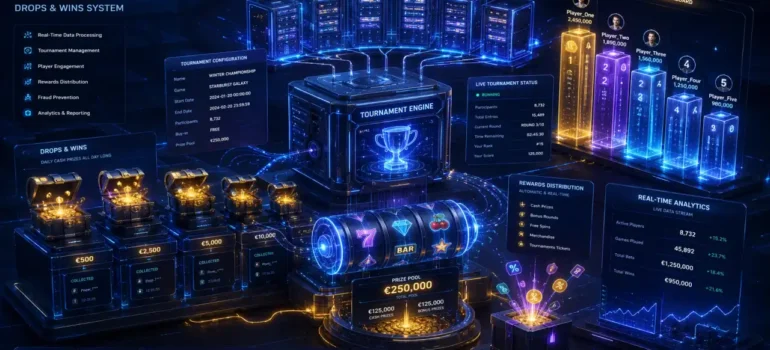
In 2026, competitive slot and live casino content alone is no longer enough to secure player loyalty; operators win or lose on their promotional engagement layer. Deploying a dedicated igaming promotional tournament engine enables operators and aggregators to run real-time prize drops, dynamic leaderboards, and personalized achievement missions across entire multi-provider catalogs without modifying underlying game code. Field data across tier-1 and mid-market operators indicates that automated promotional tools lift Gross Gaming Revenue (GGR) by 18% to 28% and extend average player session duration by over 32%. This technical guide breaks down the event-driven architecture, WebSocket telemetry, stateful prize-pool algorithms, and mathematical budgeting models required to operate zero-latency promotional mechanics at scale without eroding gaming margins.
Real-Time Promotional Engines: Building Drops, Wins & Tournaments That Lift GGR by 25%
For more than a decade, the primary growth lever for online casino operators was catalog expansion. Adding another aggregator feed or integrating 500 new slot titles was sufficient to refresh player interest. In 2026, that playbook has hit diminishing returns. Today’s players navigate vast libraries of visually stunning games with nearly identical RTP profiles and volatility curves. The true battleground for sustainable player retention and margin optimization has migrated to the promotional engagement layer. An operator armed with a high-performance igaming promotional tournament engine can transform any standard spin into a community event, an instant cash drop, or a high-stakes leaderboard race. Platforms like DYG Games have pioneered native promotional hooks directly into their RGS pipelines, demonstrating that when promotional tools operate seamlessly in real time, Gross Gaming Revenue (GGR) reliably surges by 20% to 25% across active player cohorts.
The Economics of Gamification: Why Static Bonuses Fail
Traditional deposit match bonuses and wagering-locked free spins suffer from two structural flaws: high abuse rates from bonus hunters and severe margin drag from uncalibrated liability. Furthermore, static bonus mechanics fail to deliver instantaneous psychological gratification. Modern digital entertainment consumers—conditioned by social mechanics, battle passes, and live streaming—expect immediate, transparent feedback.
Real-time promotional mechanics alter player psychology through three core behavioral loops:
- Random Prize Drops (Drops & Wins): Every qualifying wager, regardless of whether the base game produces a winning spin, carries an independent probability of triggering an instant cash, multiplier, or free-round drop. This flattens perceived volatility without altering the certified base game math model.
- Dynamic Real-Time Leaderboards: By ranking players on metrics such as highest multiplier win, consecutive win streaks, or total turnover within defined tournament windows, operators foster competitive social friction that drives wager velocity.
- Milestone Missions & Quests: Structuring challenges (e.g., “Trigger 3 bonus rounds across any mythological slot”) creates structured player progression, encouraging exploration across the operator’s broader game portfolio.
The economic impact of migrating from static bonuses to event-driven promotional mechanics is quantifiable across multiple key performance indicators:
| Promotional Mechanic | Player Retention Impact (D7/D30) | Average GGR Lift | Bonus Cost as % of Turnover |
|---|---|---|---|
| Standard Deposit Match (100% + 35x Wager) | +4.2% / +1.8% | +6.5% | 2.8% – 4.5% (High Fraud Exposure) |
| Daily Cash Drops (Configured Pool) | +18.4% / +14.2% | +19.8% | 0.6% – 1.1% (Strict Budget Cap) |
| Real-Time Multiplier Tournament | +22.1% / +16.7% | +24.6% | 0.8% – 1.4% (Fixed Prize Pool) |
| Hybrid Engine (Drops + Leaderboard + Quests) | +29.3% / +23.5% | +27.8% | 1.2% – 1.8% (Self-Funding Flywheel) |
System Architecture of a Real-Time Tournament Engine
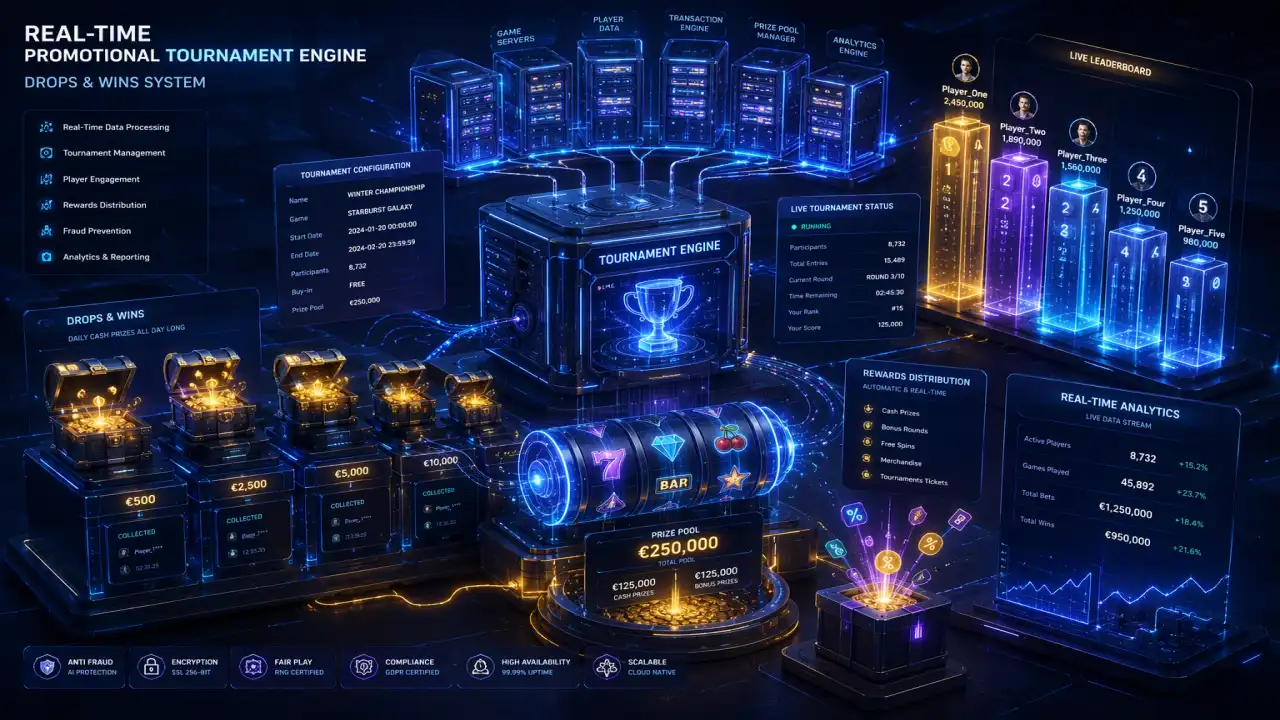
Executing zero-latency promotions requires an event-driven microservices architecture completely decoupled from core financial transaction pathways. If a tournament evaluation service encounters high load or fails, the core gameplay and wallet reconciliation must continue uninterrupted.
1. High-Throughput Telemetry Ingestion (Kafka / Event Grid)
Every spin result generated by the Remote Game Server (RGS) emits a lightweight, standardized telemetry event payload over an Apache Kafka or AWS Kinesis stream. The event envelope includes:
{
  "eventId": "evt_982347101",
  "playerId": "usr_882914",
  "sessionId": "ses_440192",
  "gameId": "dyg_slot_olympus_2026",
  "operatorId": "op_tier1_eu",
  "betAmount": 1.50,
  "winAmount": 150.00,
  "multiplier": 100.0,
  "currency": "EUR",
  "timestamp": 1776328841022,
  "featuresTriggered": ["FREE_SPINS", "MEGA_SCATTER"]
}
Because telemetry ingestion is non-blocking and decoupled from the round balance settlement, this design easily scales to handle peak volumes exceeding 50,000 transactions per second (TPS) during global festival campaigns.
2. Stateful Stream Processing (Apache Flink / Redis Streams)
Stream processing workers evaluate incoming events against active campaign rules in memory. Evaluation algorithms must handle:
- Instant Drop Eligibility: Verifying minimum qualifying bet thresholds, active player timeframes, and geo-restrictions, then executing a cryptographically secure RNG draw against remaining allocated prize items.
- Leaderboard Rank Calculation: Utilizing Redis Sorted Sets (ZADD / ZREVRANGE) with sub-millisecond read/write latency to recalculate player positions immediately upon high-multiplier wagers.
- Stateful Mission Trackers: Accumulating progress counters (e.g., tracking total wagered amounts or specific symbol counts) within Redis key-value stores backed by distributed consensus.
3. Real-Time Client Push Layer (WebSockets / gRPC)
Traditional polling architectures choke under heavy concurrency and introduce frustrating 5–10 second latency between a qualifying event and client notification. A production-grade promotional engine maintains persistent WebSocket connections with the front-end game client overlay. When a prize drop occurs, the engine pushes a visual burst notification within <120ms, rendering animations, updating prize counters, and crediting wallet balances in real time.
Mathematical Modeling: Budgeting Prize Drops Without Margin Bleed
A common operator fear is that prize drops will unpredictably cannibalize game GGR. A rigorous mathematical framework ensures that promotional prize allocations remain strictly bound to turnover or operator-sponsored marketing funds.
The Constant-Decay Drop Distribution Algorithm
To maintain high engagement throughout a 24-hour campaign window while guaranteeing that allocated prizes do not exhaust prematurely or fail to drop completely, promotional engines use a dynamic time-decay probability curve:
$$P_{drop}(t) = P_{base} \times \left(1 + \alpha \cdot \frac{N_{remaining}(t)}{T_{remaining}(t)}\right)$$
Where $P_{base}$ is the baseline drop rate per qualifying spin, $N_{remaining}(t)$ represents unclaimed prizes, $T_{remaining}(t)$ is the remaining campaign time, and $\alpha$ is a dampening constant. If spin volume accelerates unexpectedly, the probability dynamically normalizes; if volume slows down, the algorithm gradually elevates drop frequency to ensure the guaranteed daily jackpot triggers before the tournament clock expires.
Integration Strategies: In-Game Overlay vs. Aggregation API
Operators typically choose between two architectural integration models when deploying gamification features:
Model A: Embedded RGS Overlay (The DYG Native Model)
In this model, promotional UI elements (tournament sidebars, dynamic prize drop notifications, progress bars) are rendered directly inside the HTML5 game canvas via an integrated WebGL/DOM overlay managed by the game studio. Providers like DYG Games’ certified title library ship with pre-built promotional hooks. This delivers the highest visual fidelity and lowest friction, as players never leave the game interface to check standings or claim rewards.
Model B: Platform-Level PAM / Aggregation Gateway
Here, the tournament engine sits at the Player Account Management (PAM) or casino aggregation layer, wrapping third-party content in a floating web widget. While this allows cross-provider tournaments across disparate studios, it requires complex CSS framing and can suffer from visual inconsistency across mobile screen resolutions.
Step-by-Step Implementation Guide for Operators
- Define Campaign Objectives & Budget Caps: Determine whether the campaign targets acquisition (high-frequency micro-drops) or VIP turnover (high-stakes multiplier tournament). Cap total promotional budget at 1.0%–1.5% of projected campaign turnover.
- Deploy Telemetry Endpoints: Connect RGS transaction webhooks or Kafka brokers to the tournament stream ingestion cluster.
- Configure Tournament Rules: Set minimum bet filters (e.g., €0.20), scoring formulas (e.g., $Win / Bet \times 100$), and anti-collusion velocity checks.
- Test WebSocket Heartbeat & Failover: Simulate peak concurrency (25,000 active sessions) and ensure that network dropouts degrade gracefully without freezing base-game spinning.
- Review Regulatory Compliance: Ensure all prize displays clearly communicate Terms & Conditions, prize drop odds, and free-entry equivalents in jurisdictions where sweepstakes rules apply.
Frequently Asked Questions (FAQ)
Does adding a promotional engine affect certified game RTP?
No. When properly architected, promotional rewards are funded from separate marketing budgets or dedicated promotional reserve pools. The underlying math model, reel strips, and certified RNG of the base game remain completely untouched, preserving GLI, eCOGRA, and BMM regulatory compliance.
How does the engine handle multi-currency conversions during global tournaments?
All tournament leaderboards and prize allocations normalize wagers and wins against a base reference currency (typically EUR or USD) using real-time institutional FX rate feeds. Multiplier tournaments ($Win / Bet$) inherently bypass currency conversion challenges because the score is dimensionless.
Can players abuse low-bet strategies to farm prize drops?
Operators mitigate farming through minimum qualifying bet floors (e.g., €0.50) and wager-weighted probability curves, where higher wagers receive proportionally higher drop probabilities while preserving a non-zero win chance for recreational players.
What happens if a player disconnects during a prize drop event?
The tournament engine operates with transactional idempotency. If a prize drop is awarded during a disconnection, the funds credit directly to the core PAM wallet, and a persistent notification card appears as soon as the player reconnects to any participating title.
Can promotional tools be restricted by jurisdiction?
Yes. Production engines maintain jurisdictional rule tables. For instance, in markets where bonus mechanics face strict advertising or autoplay restrictions (such as the UK or Germany), specific gamification widgets can be dynamically disabled based on player geo-IP and account registration tags.
Conclusion: The Future of Real-Time Engagement
As the iGaming industry approaches 2027, the gap between top-performing operators and stagnant brands will be defined by engagement agility. Delivering seamless, real-time promotional mechanics transforms passive content consumption into an active, social, and rewarding experience. Platforms looking to maximize player lifetime value and defend operating margins must make an event-driven igaming promotional tournament engine a foundational pillar of their technology roadmap.
Explore DYG Games’ latest architectural insights or reach out to our solutions team to integrate real-time promotional tools into your game portfolio today.