

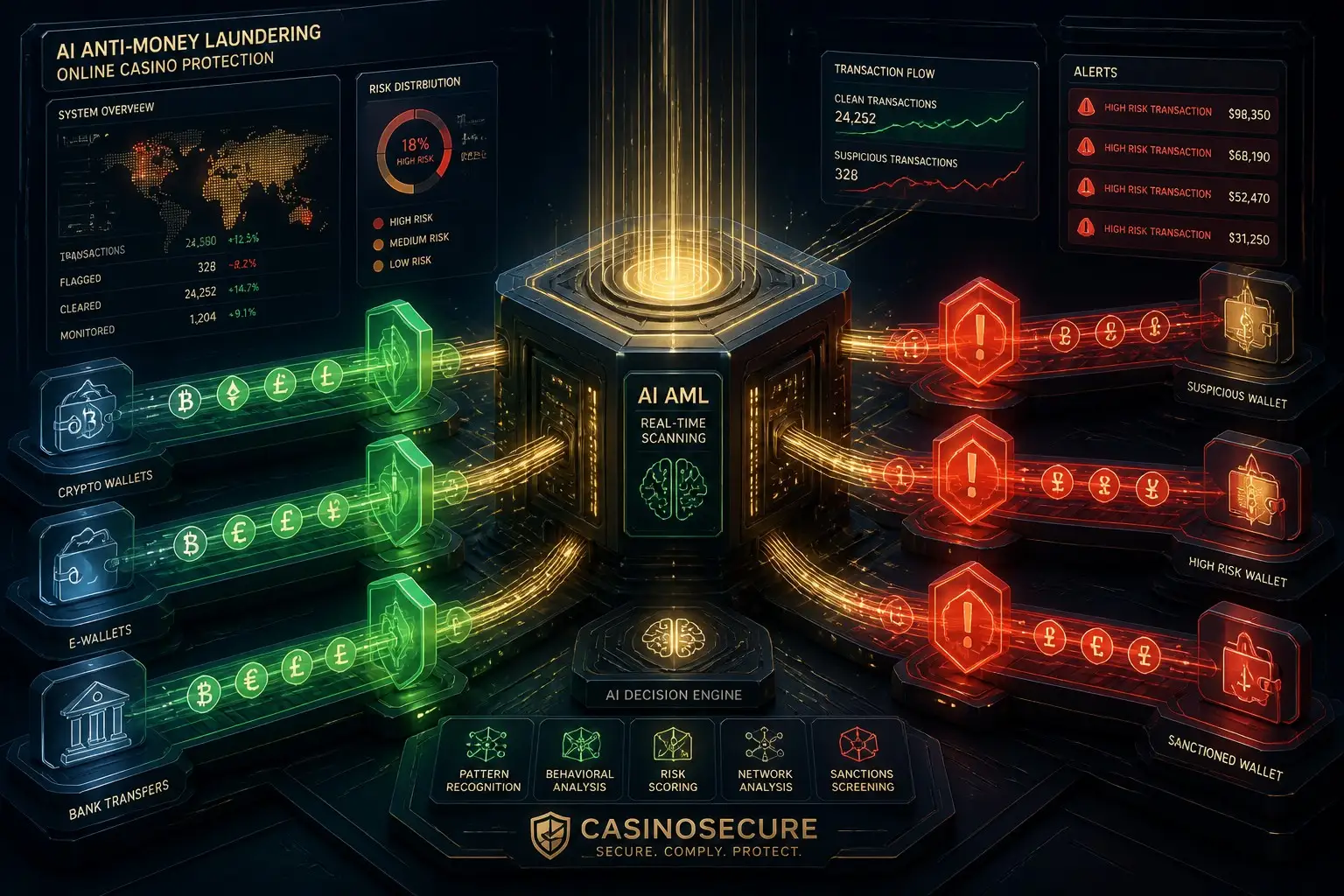
Regulatory fines for AML failures in the iGaming sector reached record levels in the first half of 2026. The lesson is unambiguous: static, rule-based transaction monitoring is obsolete. Modern criminal networks adapt faster than compliance teams can update thresholds. At DYG, our Real-Time AML 2.0 architecture applies machine learning to the entire transaction graph—not just individual transactions—to uncover the network patterns that define organized financial crime in online casinos.
The 2026 Money-Laundering Threat Landscape
Traditional AML systems flag a single suspicious deposit. Modern schemes are designed to defeat exactly that. The 2026 threat model includes:
- Micro-Structuring: Hundreds of small deposits just under reporting thresholds, spread across dozens of accounts.
- Account Farming: Automated creation of “clean” player accounts that are seasoned over weeks, then used for a single large flow.
- Instant Settlement Arbitrage: Exploiting the speed of stablecoin cashouts to move funds through the gaming layer in minutes, before manual review can intervene.
- Collusion Networks: Coordinated play between accounts to transfer value through game outcomes rather than direct transfers.
How AI-Based AML Detects the Undetectable
1. Graph Neural Network Transaction Analysis
Instead of evaluating transactions in isolation, DYG’s AML engine constructs a live transaction graph. Every player, wallet, device fingerprint, and game session becomes a node. The AI analyzes relationships—shared devices, timing correlations, value-flow vectors—to identify “communities” of accounts that behave as a single criminal unit. This is the technical core of iGaming AML 2026.
2. Behavioral Velocity Scoring
Beyond amounts, the engine scores behavioral velocity: how quickly a new account ramps to high-volume activity, how often funds are withdrawn immediately after deposit, and whether gameplay is “suspiciously suboptimal” (players deliberately losing to transfer value). Each signal adds to a composite risk profile updated in milliseconds.
3. Adaptive Threshold Learning
Criminals calibrate their activity to stay under static thresholds. Our AI continuously learns what “normal” looks like per region, per game, and per payment rail, then adapts thresholds dynamically. A deposit pattern that was normal in January becomes flagged in June the moment the model sees it correlating with other risk indicators.
Operational Integration: Compliance Without Friction
Real-time AML must not throttle legitimate gameplay. DYG’s system operates in a tiered-response model:
- Monitor (low risk): Transactions flow normally; signals logged for periodic review.
- Soft-Hold (medium risk): The payout is delayed by a configurable window while the AI performs deeper network analysis.
- Freeze + Escalate (high risk): Funds are frozen, the compliance officer receives a structured case file, and the regulator’s reporting endpoint is notified automatically.
This graduated approach ensures that the 99.5% of legitimate players experience zero delay, while the 0.5% of suspicious flows are stopped before funds leave the platform.
Synergy with the DYG Protection Stack
AML 2.0 shares infrastructure with our AI-driven responsible gaming engine. Both consume the same real-time event streams and both write to the same immutable audit ledger. For operators running multiple jurisdictions, this means a single compliance backbone that simultaneously satisfies MGA, UKGC, and Curacao reporting obligations. It is the same architectural philosophy we apply to zero-latency settlement systems, ensuring financial integrity from deposit to payout.
AML Detection Capabilities
- Graph Network Analysis
- Micro-Structuring Detection
- Adaptive Threshold Learning
Compliance Outcomes
- Reduced Regulatory Fines
- Faster SAR Filing
- Bulletproof Audit Trails
Industry Context: The Cost of AML Failure
The regulatory environment of 2026 has made AML capability a licensing currency. Enforcement statistics across the first half of the year show a clear pattern: regulators are imposing record penalties not for isolated failures but for systemic monitoring gaps. In one high-profile European case, an operator was fined for failing to detect a laundering ring that moved funds through a network of more than 200 player accounts over six months. The suspicious pattern—coordinated deposits, suboptimal gameplay, and rapid withdrawals—was invisible to the operator’s rule-based system but structurally obvious to graph-based analysis.
The economic case for proactive AML is not limited to fine avoidance. When a laundering ring is detected late, the operator bears the cost of processing chargebacks, freezing contested balances, and defending the brand in the media. Detection latency is expensive in multiple dimensions. DYG’s Real-Time AML 2.0 architecture directly targets this latency: the graph-analysis layer identifies network-level patterns in seconds rather than weeks, and the tiered-response model contains the flow before funds exit the platform.
There is also a market-access dimension. Payment providers are increasingly requiring demonstrable AML capability as a condition of service. Operators running legacy monitoring systems face a growing risk of payment-rail termination, which in turn threatens player experience and revenue. The same payment partners that demand AML rigor are those that enable the stablecoin settlement rails central to modern distribution. Compliance capability, in this sense, is not merely defensive—it is a prerequisite for participating in the 2026 payment ecosystem.
For B2B decision-makers, the strategic implication is direct: AML technology is now a procurement criterion, not a compliance footnote. The evaluation framework used for payment providers and platform vendors should include a demonstrated AML capability with graph-based detection, adaptive thresholds, and regulator-ready reporting. The cost of upgrading this capability after a failure event is invariably higher than building it into the platform selection from the start.
Implementation Blueprint for Operators
Deploying AI-powered AML is a cross-functional project spanning finance, compliance, and engineering. DYG provides a structured rollout that has been executed successfully across more than a dozen licensed operators in 2026.
Step 1: Data and Signal Integration
The AML engine needs access to transaction events, wallet metadata, and gameplay telemetry. During the first integration sprint, DYG’s team maps these feeds through the standard API family, ensuring that the graph-analysis layer sees the same high-resolution event stream that powers personalization and protection. For operators with legacy backends, a lightweight event-forwarding shim provides full coverage without requiring a platform migration.
Step 2: Model Validation Against Historical Cases
Before going live, the engine is validated against the operator’s historical suspicious-transaction archive. The AI must recall known cases with high precision—flagging them with the severity they deserved—while keeping false-positive rates below the industry benchmark. This validation window also produces the model-governance documentation that regulators increasingly request during license audits.
Step 3: Escalation Workflow Configuration
Every operator already has an AML officer and an escalation path. DYG’s system slots into that path rather than replacing it: the AI generates structured case files with the evidence trail, the officer reviews and confirms or overrides, and the system learns from each human decision. Over time, the model’s precision improves as it absorbs operator-specific judgment calls.
Frequently Asked Questions
How does the system handle false positives without alienating players?
False positives are the classic tension in AML systems—too aggressive and legitimate players suffer; too lenient and criminal flows pass. DYG’s engine addresses this with a layered confidence model: low-confidence signals trigger monitoring and soft-hold only, while high-confidence signals with network-level corroboration escalate directly. Over time, the model learns operator-specific judgment through the human review loop, continuously reducing false-positive rates while maintaining detection precision.
Will the AML engine slow down legitimate payouts?
No. Only the smallest fraction of transactions (those exceeding medium-risk thresholds) enter the soft-hold state, and the review window is configurable—typically 10-30 minutes. The remaining 99.5% of flows proceed at full speed. Operators can tune the balance between review rigor and payout velocity to match their market position and regulatory appetite.
What happens when a regulator requests a report?
The system generates regulator-ready suspicious-activity summaries automatically. Each report includes the network evidence, the risk signals that triggered the alert, and the officer’s disposition. Because every event is logged to the immutable audit trail, reports can be produced in minutes rather than days, dramatically reducing regulatory-response pressure.
Can the engine handle stablecoin and fiat transactions together?
Yes. The graph layer treats all payment rails uniformly—fiat wallets, card transactions, and stablecoin addresses are all nodes in the same analysis graph. This unified view is essential in 2026, where mixed-rail laundering schemes increasingly exploit the seam between crypto and fiat settlement.
Is this compatible with our existing KYC provider?
Yes. The AML engine consumes KYC tiering data from your existing provider and incorporates it as one input among many. There is no requirement to replace your KYC vendor; DYG’s system complements rather than substitutes your current identity-verification stack.
Conclusion: The New Standard of Financial Trust
In 2026, the ability to detect sophisticated money-laundering networks in real time is no longer a differentiator—it is the price of admission for global operations. AI-powered anti-money-laundering transforms compliance from a reactive cost center into a proactive shield for your brand. DYG delivers this capability as a native part of the backend, tested against real-world 2026 threat patterns and ready for the next generation of regulatory scrutiny.
Strengthen your compliance posture. Contact DYG’s financial crime team for a live demonstration of the Real-Time AML 2.0 engine.