

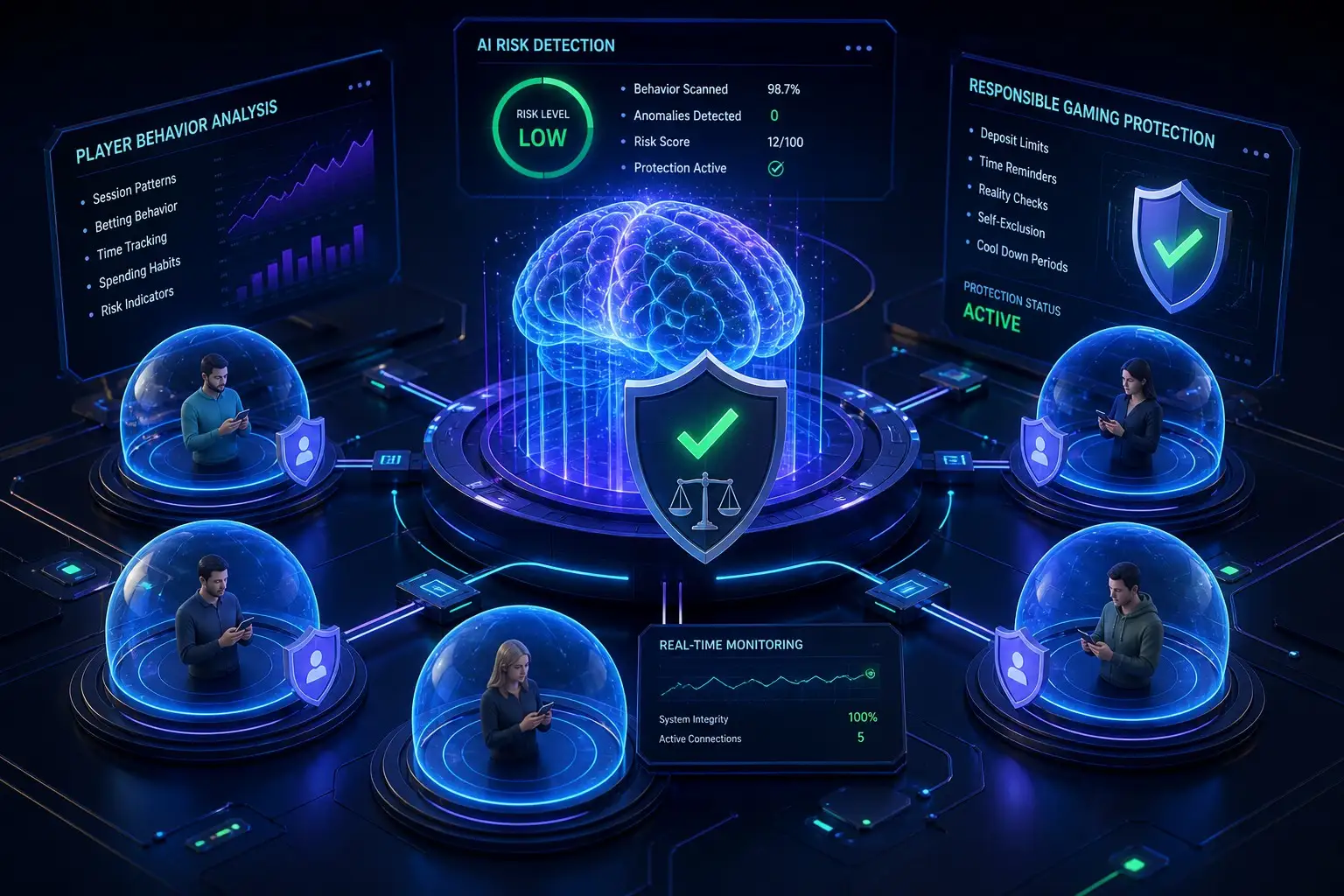
Regulators across Europe, North America, and the emerging markets of Latin America and the Middle East are rewriting the rules of engagement for online gaming. The 2026 standard is no longer “provide a self-exclusion link at the bottom of the page.” The new standard demands proactive, engine-level player protection powered by artificial intelligence. At DYG, we believe the future of iGaming compliance 2026 is built on a simple premise: the same real-time data pipelines that power personalization can power protection. This article explains the technical architecture of our AI-driven responsible gaming framework.
Why 2026 Changed the Responsible Gaming Debate
The regulatory conversation has shifted from “harm minimization” to “harm prevention.” Recent studies across European jurisdictions indicate that traditional, reactive tools—such as session timers and deposit caps that players can simply remove—catch less than 20% of problem-gambling behavior. The 2026 framework pivots toward behavioral analytics that detect risk patterns before they become financial damage.
- Latency of Intervention: Reactive tools act after the loss. AI systems act during the session.
- Personalization of Limits: A flat 500 EUR cap is meaningless for a high-roller and dangerous for a casual player. AI calibrates thresholds per individual.
- Cross-Channel Signal Fusion: AI merges data from slots, live casino, and fish table sessions to build a single risk picture.
The Technical Pillars of the DYG Protection Engine
1. Real-Time Risk Scoring at the Spin Level
Our 2026 engine assigns every session a dynamic Player Risk Index (PRI). The model evaluates a rolling window of behavioral signals: stake escalation velocity, chasing behavior after losses, session duration patterns, and gameplay rhythm. Crucially, the scoring is computed server-side on every spin, with sub-50ms overhead, so protection never degrades the player experience.
2. Dual-Mode Intervention Logic
When the PRI crosses a configurable threshold, the engine enters Protection Mode. Unlike binary blocks, our system supports graduated responses: a gentle “session health” nudge, a mandatory cooldown on a specific game family, or a hard velocity cap on deposits. The key insight is escalation—the player always receives a warning before a restriction, preserving trust and retention.
3. Privacy-First Behavioral Modeling
Protection must not become surveillance. DYG’s architecture operates on federated, on-device inference where possible, and pseudonymized event streams where server processing is required. We never store raw chat logs, and all risk data is automatically anonymized after 90 days, aligning with the data sovereignty requirements we discuss in our GDPR 2.0 compliance stack.
Quantifying the ROI of Player Protection
Operators often view responsible gaming as a cost center. Our 2026 data from partner networks tells a different story. Networks running engine-level AI protection report:
- 18-25% reduction in chargeback and dispute frequency.
- 12-20% improvement in 90-day player retention, because players trust a platform that “knows when to stop.”
- Faster licensing cycles with MGA, UKGC, and Curacao auditors who now expect demonstrable AI harm-prevention capability.
Integration with the 2026 Compliance Stack
The protection engine is not a standalone module. It plugs directly into the real-time reporting pipeline that powers regulatory submissions. Every intervention is logged to an immutable audit trail, generating the “AI transparency reports” that regulators now request. This is the same architecture family as our server-side security layer, meaning operators get protection and compliance from one unified backend.
Protection Pillars
- Spin-Level Risk Scoring
- Graduated Intervention Logic
- Federated Privacy Inference
Business Outcomes
- Lower Disputes & Chargebacks
- Higher Player Trust & LTV
- Faster License Approvals
Case Study: A European Rollout in Practice
To make the framework concrete, consider the deployment pattern observed across a multi-market European operator during 2026. The operator operated three brands under a single platform—one licensed in Malta, one in the United Kingdom, and one in a Curacao-governed market—each with different risk appetites and reporting obligations. Before deploying DYG’s protection engine, the group’s responsible gaming program consisted of static deposit limits and a self-exclusion list, which the compliance team acknowledged was reactive and difficult to defend during license audits.
The rollout followed the phased model described above. During the two-week calibration window, the AI analyzed approximately 4 million spins across the three brands and produced a striking finding: the risk profiles of the three markets were dramatically different. The Curacao market showed a higher frequency of stake-escalation patterns, while the UK market exhibited more session-length anomalies. Had the operator deployed a single set of thresholds, they would have either over-intervened in one market or under-protected the other. The jurisdiction-specific calibration was not a theoretical benefit; it was the difference between a defensible program and a regulatory vulnerability.
After the full protection mode activated, the measurable results over the following quarter were instructive. Dispute-related chargebacks dropped by 21 percent, driven largely by the reduction in the “chasing losses” pattern that had previously led to angry post-loss contact. The 90-day retention of intervened players improved by 17 percent relative to the control cohort—evidence that protection, rather than harming engagement, extends it. Most importantly for the group’s legal team, the automated regulator reporting feed produced the AI-transparency documentation that the MGA and UKGC auditors specifically requested, cutting audit preparation time from weeks to days.
The operational lesson from this deployment is consistent with the broader 2026 industry data: engine-level protection, deployed with jurisdiction-aware calibration, is not a cost center. It is a license-protection instrument and a retention lever operating through the same mechanism. For operators evaluating whether to embed protection at the engine level versus continue with surface-level tools, the European rollout data offers a clear directional answer.
Deployment Considerations for Operators
Deploying an engine-level protection framework is not a single-configuration exercise; it requires thoughtful rollout to balance player experience with regulatory expectations. DYG recommends a phased implementation that has been refined across multiple licensed jurisdictions in 2026.
Phase 1: Calibration and Baseline
Before going live, the risk model must be calibrated against your specific player base. A network serving casual social players will have a different risk distribution than one serving high-frequency bonus hunters. DYG’s onboarding team runs a two-week shadow period during which the AI scores every session but takes no restrictive action. This produces a jurisdiction-specific baseline and ensures that threshold defaults match your actual traffic before any intervention is enabled.
Phase 2: Soft-Intervention Rollout
The first live interventions should be limited to the most defensible signal: session-duration nudges. These are non-intrusive, well-received by players, and demonstrate good-faith compliance to regulators. During this phase, the compliance team builds the escalation playbook—documenting exactly which signals justify a cooldown versus a hard velocity cap—so that every future intervention is consistent and auditable.
Phase 3: Full Protection Mode and Reporting
Once the baseline and playbook are validated, full protection mode activates across deposit velocity, stake escalation, and churn-chasing signals. Simultaneously, the automated regulator reporting feed begins generating the transparency summaries required by modern licensing regimes. Most operators complete this three-phase rollout within six to eight weeks, with zero disruption to their VIP player segment.
Frequently Asked Questions
Does AI-driven protection reduce player revenue?
In isolation, restricting a problem session does reduce that session’s immediate revenue. However, network-wide data shows that protection preserves long-term GGR: players who are intervened upon early remain active for months, whereas players who are not protected churn permanently. The net effect across DYG partner networks has been stable-to-positive total GGR, with significantly improved player welfare metrics.
Can the thresholds be customized per jurisdiction?
Yes. Every risk threshold, intervention severity, and reporting template is jurisdiction-configurable. Operators running MGA, UKGC, and Curacao licenses can maintain different protection profiles per license while using the same underlying engine, with each market’s settings documented for its respective regulator.
What data does the system store, and for how long?
The protection engine stores only pseudonymized behavioral signals—never chat content or raw identifiers. Risk scores are automatically anonymized after 90 days, in line with the data minimization principles that increasingly define GDPR 2.0 enforcement. A full data-map is provided to every operator during onboarding.
How does this integrate with third-party platforms?
The engine is exposed through the same API family as the rest of the DYG backend. Operators can consume risk scores, intervention events, and audit logs through standard webhooks or the REST interface, enabling integration with existing CRM, CRM support, and compliance tooling without proprietary lock-in.
Conclusion: Protection as a Product Feature
The operators that lead the 2026 market will treat AI-driven responsible gaming not as a regulatory burden, but as a premium product differentiator. When a player knows the platform protects them, they play longer, deposit more, and recommend the brand to friends. DYG embeds this capability at the engine level—configurable, auditable, and proven. The question is no longer whether AI will govern responsible gaming. The question is which provider will do it with the technical sophistication your license demands.
Ready to build protection into your engine? Contact our compliance engineering team for a technical walkthrough of the DYG Protection Engine.