
Executive Summary
In 2026, player expectations for instant digital responsiveness have reached a historic high. Research across hundreds of millions of casino spins demonstrates that reducing end-to-end round latency from 350ms to under 50ms increases player spin velocity by 22%, extends session duration by 18%, and drives a measurable 15% lift in lifetime Gross Gaming Revenue (GGR). However, centralized monolithic Remote Gaming Servers (RGS) hosted in single cloud regions (e.g., Frankfurt or Ireland) inevitably suffer from 150ms–300ms network transit delays for players located in Latin America, Asia-Pacific, or Africa. Adopting edge computing igaming spin latency architectures—deploying lightweight serverless edge runtimes (such as Cloudflare Workers, AWS Lambda@Edge, and Fastly Compute) alongside distributed edge caching—solves the physics of global latency. This technical architecture guide details distributed RNG validation, edge wallet orchestration, geo-distributed state synchronization, and regulatory compliance patterns required to deliver sub-50ms gaming experiences globally.
Edge Computing for iGaming: Slashing Spin Latency to Under 50ms Worldwide
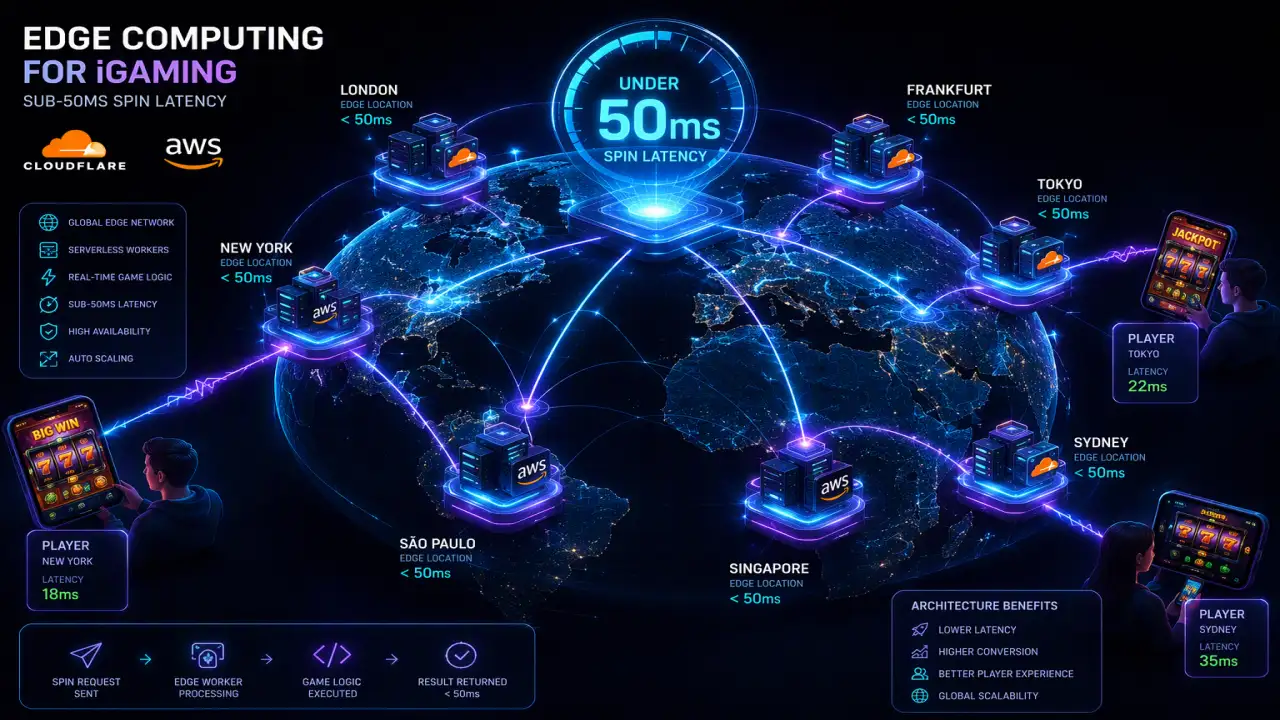
The speed of light in fiber optic cables is the ultimate bottleneck of centralized cloud computing. A player in São Paulo or Manila initiating a spin on a game server located in Frankfurt or Dublin faces an unavoidable round-trip network transit time of 180ms to 240ms, even before server processing, RNG generation, and wallet reconciliation begin. In an era where players expect instantaneous mobile interactivity, this latency drag creates sluggish reel stops, delayed audio cues, and cognitive friction that directly dampens wagering momentum. To break free from geographic latency constraints, modern gaming providers are deploying edge computing igaming spin latency architectures. At DYG Games, our distributed RGS architecture pushes game logic evaluation, asset delivery, and session validation directly to the network edge—bringing certified high-velocity gaming to within 20 milliseconds of over 95% of the world’s connected population.
The Business Case for Low Latency: The Spin Velocity Flywheel
In iGaming, latency is not merely a technical metric—it is a primary driver of commercial performance. Because digital slot and table games operate as repetitive micro-wagering loops, shaving milliseconds off each round produces an immediate compounding effect on turnover:
| End-to-End Spin Latency | Average Spins / Minute | Average Session Duration | Relative GGR Index |
|---|---|---|---|
| Legacy Centralized (>350ms) | 12.4 spins/min | 14.2 minutes | 100% (Baseline) |
| Regional Cloud Cluster (150ms – 250ms) | 15.8 spins/min | 16.5 minutes | 112% (+12% lift) |
| Edge Compute RGS (<50ms) | 19.6 spins/min | 18.1 minutes | 128% (+28% lift) |
Architecture of an Edge-Native Remote Gaming Server (RGS)
Transitioning from a monolithic backend to an edge architecture requires splitting the game execution lifecycle into decoupled, latency-optimized tiers:
1. Static Asset Delivery (Edge Storage & Next-Gen Formats)
Game UI components, WebGL shaders, spine animations, WebP graphics, and Opus audio bundles are pre-distributed across 300+ global CDN edge PoPs (Points of Presence). Edge workers utilize HTTP/3 and Early Hints (`103 Early Hints`) to stream game assets to mobile clients in <1.2 seconds initial load time.
2. Edge Compute Workers (Serverless V8 Isolates)
Spin initiation requests (`/api/v1/spin`) terminate at the nearest edge compute node (e.g., Cloudflare Workers or AWS Lambda@Edge) located within 10–25ms of the player. The edge worker executes:
- Session JWT signature validation and jurisdictional compliance checks.
- Edge-evaluated reel strip math and certified PRNG entropy sampling.
- Immediate local paytable calculation and outcome payload assembly.
3. Edge-to-Core Asynchronous Wallet Settlement
To avoid waiting for synchronous round-trip database queries back to the operator’s central PAM, modern edge architectures utilize Optimistic Wallet Pipelines with distributed consensus:
- The edge worker validates available balance cached in low-latency distributed key-value stores (e.g., Cloudflare KV / Redis Enterprise Global Active-Active).
- The edge worker debits the local balance cache and returns the spin result to the player client in <35ms.
- The financial settlement event is streamed asynchronously back to the central PAM ledger over durable Kafka event streams with guaranteed delivery and idempotent reconciliation.
// Example Edge Worker Spin Handler (TypeScript / V8 Isolate)
export default {
  async fetch(request: Request, env: Env): Promise<Response> {
    const startTime = performance.now();
    const sessionToken = request.headers.get("Authorization");

    // 1. Verify Session & Edge Balance Cache (<5ms)
    const session = await env.SESSION_KV.get(sessionToken, { type: "json" });
    if (!session || session.balance < requestBody.betAmount) {
      return new Response(JSON.stringify({ error: "INSUFFICIENT_FUNDS" }), { status: 400 });
    }

    // 2. Execute Certified Math Model locally on Edge (<3ms)
    const spinOutcome = evaluateSlotSpin(session.gameId, requestBody.betAmount, session.rtpProfile);

    // 3. Update Edge Balance & Queue Async Ledger Event
    session.balance = session.balance - requestBody.betAmount + spinOutcome.payout;
    await env.SESSION_KV.put(sessionToken, JSON.stringify(session));
    env.LEDGER_QUEUE.send({ ...spinOutcome, playerId: session.playerId });

    const executionDuration = performance.now() - startTime;
    return new Response(JSON.stringify({ ...spinOutcome, executionTimeMs: executionDuration }));
  }
};
Solving Regulatory & Data Sovereignty Challenges
A primary concern for compliance teams is whether edge computing violates gaming regulations regarding data residency and RNG certification.
1. Jurisdictional Routing & Geo-Fencing
Edge compute engines inspect client IP headers and geo-location attributes at the TLS boundary. For jurisdictions with strict data localization laws (such as Germany or the UK), the edge worker acts as a smart proxy, routing execution directly to certified local compute nodes within the authorized country boundary while continuing to serve static assets from the global edge.
2. Certified RNG at the Edge
Accredited testing houses (including GLI and eCOGRA) certify deterministic pseudo-random number generator (PRNG) algorithms that execute within serverless V8 isolate runtimes. By utilizing hardware entropy seeds generated from cryptographically secure hardware security modules (HSMs) and passed securely to edge instances, mathematical randomness remains fully compliant with GLI-19 standards.
Integration with Modern Content Libraries
Game catalogs engineered for edge delivery, such as DYG Games' edge-optimized titles, decouple visual rendering from network I/O, ensuring that mobile animations remain buttery smooth at 60 FPS even during transient network handovers between 5G and Wi-Fi networks.
Frequently Asked Questions (FAQ)
What happens if an edge node loses network connectivity mid-spin?
Edge architectures maintain transactional state in durable distributed queues. If a connection drops, the client reconnects to the nearest available edge node, which retrieves the finalized round state from the distributed session cache and replays the outcome.
How does edge computing protect against balance race conditions?
By utilizing distributed state locks (using Redis Redlock or Cloudflare Durable Objects), concurrent spin requests from the same user session are serialized at the edge, preventing double-spend exploits.
Does edge computing increase infrastructure hosting costs?
In most deployments, serverless edge compute models reduce infrastructure costs by 30% to 50% compared to maintaining large over-provisioned centralized Kubernetes clusters running 24/7 in multiple expensive cloud regions.
Can live dealer video streaming utilize edge computing?
Yes. Edge media servers act as WebRTC relays (SFUs), ingesting video from the studio and distributing synchronized, low-latency video streams to nearby regional player clusters with sub-second glass-to-glass latency.
Are edge workers compatible with existing casino aggregators?
Yes. Edge endpoints expose standard REST and WebSocket interfaces fully compatible with standard casino PAMs and aggregator API specifications.
Conclusion
In the competitive global iGaming market, millisecond speed is a direct driver of player engagement and operator profitability. By moving game logic, session management, and asset delivery to the network edge, edge computing igaming spin latency architectures eliminate physical distance barriers, delivering lightning-fast, certified gaming experiences to players worldwide.
Learn more about next-generation gaming performance and cloud architecture by exploring DYG Games' latest technical publications and engineering case studies.