
Executive Summary
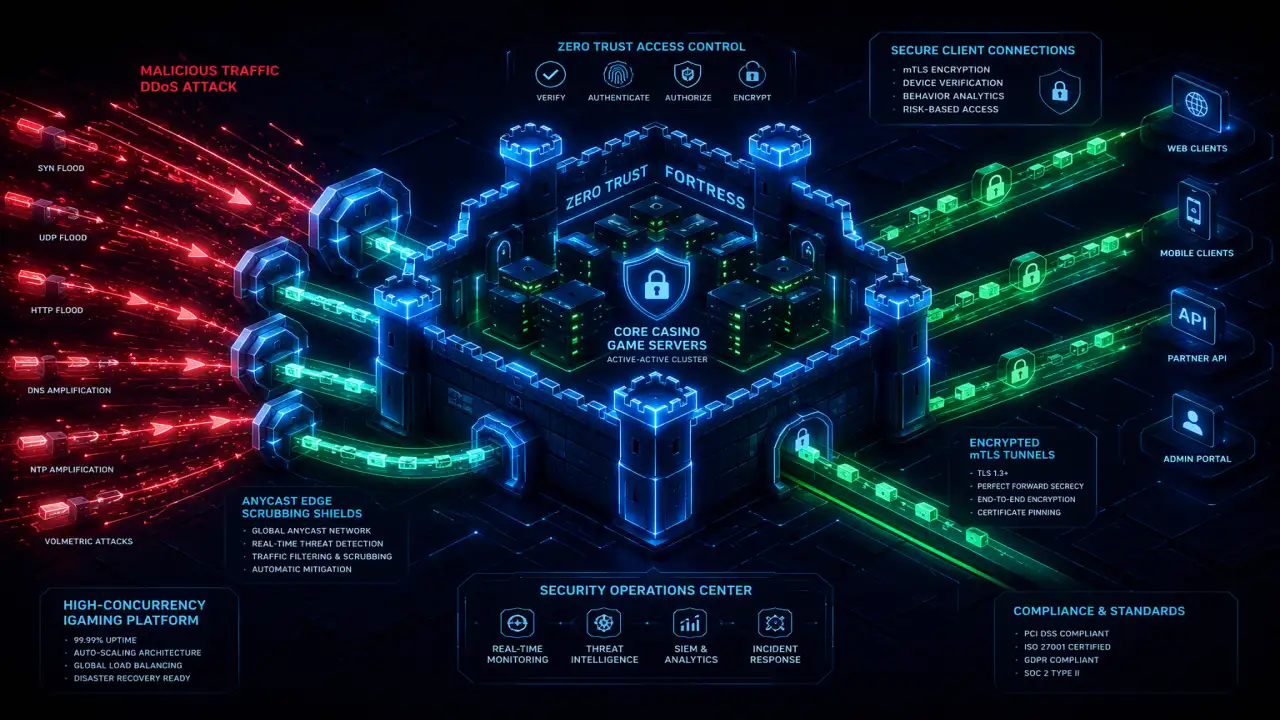
In 2026, iGaming platforms and Remote Gaming Servers (RGS) represent prime targets for sophisticated cyber threats, including multi-terabit volumetric Distributed Denial of Service (DDoS) assaults, Layer 7 API credential stuffing, and botnet-driven slot spin replay exploits. Downtime during major global sporting events or high-traffic weekend peaks costs Tier-1 operators upwards of $100,000 per hour in lost Gross Gaming Revenue (GGR) and permanent player churn. Establishing robust igaming api security ddos mitigation requires moving beyond legacy perimeter firewalls to a comprehensive Zero-Trust architecture. This technical guide outlines edge scrubbing methodologies, cryptographic request signing, behavioral bot management, and high-concurrency rate limiting topologies designed to maintain sub-15ms API response times while neutralizing complex cyber attacks.
Defending the Spin: DDoS Mitigation & Zero-Trust Security for High-Concurrency Game APIs
The iGaming sector operates in one of the most hostile cybersecurity environments on the public internet. High financial turnover, real-time transaction processing, and fierce market competition make gaming operators and B2B game providers frequent targets of extortionate DDoS campaigns, automated credential-stuffing syndicates, and sophisticated API abuse. Unlike standard e-commerce websites where brief page-load delays are tolerated, online casino platforms demand uninterrupted, real-time state synchronization. A 3-second API latency spike during a high-stakes slot spin or live roulette bet results in dropped sessions, bet voids, and regulatory audit inquiries. Building enterprise-grade igaming api security ddos mitigation requires an end-to-end Zero-Trust posture where every API call, wallet debit, and RNG spin request is continuously verified. At DYG Games, our RGS infrastructure is architected to withstand massive Layer 3/4 and Layer 7 volumetric spikes while guaranteeing 99.999% platform availability.
The 2026 Threat Landscape in iGaming
Cyber adversaries target online gaming operations through three distinct vectors:
1. Volumetric Layer 3 / Layer 4 DDoS Attacks
Massive UDP/SYN floods exceeding 1.5 to 3.0 Tbps targeting DNS servers, gaming domain IP ranges, and edge ingress routers to saturate network bandwidth and sever player connections during peak betting windows (such as World Cup matches, Super Bowl Sunday, or major festival campaigns).
2. Application-Layer (Layer 7) API Floods & Slowloris
Low-and-slow HTTP POST requests mimicking legitimate `/api/v2/spin` or `/api/v2/wallet/debit` calls. Because these requests establish valid TLS handshakes and pass standard IP firewalls, they exhaust backend application server thread pools, database connection queues, and RNG worker nodes without triggering volumetric network alarms.
3. Automated Botnets & Reverse Engineering Exploits
Syndicates deploy headless browser botnets to scrape promotional bonus endpoints, execute high-velocity credential stuffing against player accounts, or attempt replay attacks against game transaction tokens to manipulate payout calculations.
| Attack Vector | Target Layer | Primary Impact | Defensive Mechanism |
|---|---|---|---|
| Volumetric UDP/ICMP Flood | Layer 3 / 4 (Network) | Total bandwidth saturation; site offline | Global Anycast Edge Scrubbing (Cloudflare / AWS Shield) |
| Layer 7 HTTP Spin Flood | Layer 7 (Application) | RGS thread starvation; database crash | Adaptive Rate Limiting + Token Bucket Algorithms |
| Credential Stuffing & Account Takeover | Layer 7 (Auth Endpoints) | VIP wallet draining; compliance fines | Behavioral Biometrics + ML Bot Scoring |
| API Replay / Man-in-the-Middle | API Integration Layer | Fraudulent balance manipulation | mTLS + HMAC Request Signing + Nonce Verification |
Zero-Trust Architecture for RGS & Aggregator APIs
A Zero-Trust security model assumes that perimeter defenses will be breached and enforces strict mutual authentication, least-privilege authorization, and cryptographic verification across every microservice hop.
1. Mutual TLS (mTLS) for B2B Server-to-Server Integrations
Between the Operator’s Player Account Management (PAM) platform and the game studio’s Remote Gaming Server (RGS), all communication is locked behind mutual TLS (mTLS) using X.509 client certificates with strict IP whitelisting. This ensures that unauthorized third parties cannot probe or spoof internal wallet endpoints.
2. Cryptographic HMAC Request Signing with Anti-Replay Nonces
Every spin initiation and balance debit request includes an authenticated HMAC-SHA256 signature calculated over the request body, timestamp, and a single-use cryptographic nonce:
// Example Secure API Ingress Header Validation
const expectedSignature = crypto
  .createHmac('sha256', API_SECRET_KEY)
  .update(`${timestamp}.${nonce}.${JSON.stringify(requestBody)}`)
  .digest('hex');

if (incomingSignature !== expectedSignature) {
  throw new SecurityException('INVALID_HMAC_SIGNATURE');
}

// Anti-Replay Nonce Verification via Redis SETNX (TTL: 60s)
const isUnique = await redis.set(`nonce:${nonce}`, '1', 'EX', 60, 'NX');
if (!isUnique) {
  throw new SecurityException('REPLAY_ATTACK_DETECTED');
}
High-Concurrency Edge Protection & Adaptive Rate Limiting
To defend against Layer 7 application floods without degrading performance for legitimate high-frequency players, security engines implement distributed Token Bucket and Leaky Bucket rate limiters running at the CDN edge:
1. Multi-Tier Rate Limiting Topologies
- Global IP Tier: Caps raw HTTP requests per IP (e.g., maximum 50 req/sec) to block rudimentary scraper bots.
- Session / Player Token Tier: Enforces granular game-specific spin limits (e.g., maximum 1 spin per 2.0 seconds per active session token), ensuring that automated click scripts cannot overwhelm RNG pipelines.
- Wallet Endpoint Tier: Restricts financial transaction endpoints to strict transactional cadences, isolating cashier operations from general gameplay traffic.
2. Behavioral Bot Scoring & Challenge Injection
Rather than using intrusive legacy CAPTCHAs that disrupt gameplay, edge security tools evaluate silent browser telemetry (TLS fingerprinting, HTTP/2 header order, WebGL canvas anomalies, and mouse/touch trajectory metrics). Traffic scoring above threshold risk is routed to low-priority background queues or challenged with invisible Proof-of-Work (PoW) cryptographic puzzles that consume attacker CPU cycles while remaining imperceptible to real users.
High Availability & Disaster Recovery Failover
Enterprise platforms powered by DYG Games’ secure RGS platform deploy active-active multi-region cloud clustering across geographically distributed data centers (AWS, Google Cloud, and private bare-metal gaming clouds). If a primary data center faces an overwhelming upstream transit failure or localized power outage, global Anycast DNS automatically reroutes traffic to healthy secondary nodes within 2.5 seconds, ensuring seamless session continuity.
Frequently Asked Questions (FAQ)
How does DDoS mitigation impact game latency and spin speed?
Properly configured edge scrubbing networks (utilizing Anycast routing) add less than 5–10ms of latency. Game state processing and cryptographic checks execute in parallel memory pipelines, preserving seamless sub-50ms spin execution.
Can attackers alter game outcomes by intercepting network traffic?
No. All game math calculations, RNG outcome derivations, and paytable evaluations execute strictly within isolated backend server environments. The client receives only certified outcome payloads encrypted over TLS 1.3.
What is the role of mTLS in preventing fraud?
mTLS establishes mutual cryptographic identity verification between the casino operator and the game provider. Even if an attacker discovers internal API endpoint URLs, they cannot make valid calls without the matching private cryptographic certificate.
How are high-volume live casino video streams protected from DDoS attacks?
Live video feeds utilize distributed WebRTC media relays and low-latency CDN edge nodes that absorb volumetric spikes, completely segregating real-time video distribution from core financial settlement APIs.
Are these security protocols certified under ISO 27001 and gaming regulations?
Yes. Production iGaming platforms undergo regular third-party penetration testing, vulnerability audits, and ISO 27001 information security certifications required by top-tier licensing authorities such as the UKGC, MGA, and GLI.
Conclusion
In the modern iGaming ecosystem, system security and platform uptime are fundamental commercial differentiators. By adopting a Zero-Trust architecture, enforcing cryptographic HMAC request signing, and deploying intelligent edge DDoS scrubbing, operators and game providers defend their brand reputation, safeguard player balances, and ensure continuous revenue generation under all operational conditions.
Read more about enterprise-grade gaming infrastructure by checking DYG Games’ latest technical engineering publications.