

Industry analysts project the online gaming sector to surpass $143 billion in gross revenue during 2026. Yet across this expanding market, a persistent paradox remains: acquisition costs rise every year while the average player lifetime shortens. The operators who break this cycle have discovered that player lifetime value is not a fixed input—it is a variable that responds powerfully to personalization. At DYG, our AI personalization engine operates at the game-logic level, adapting the experience in real time to maximize both engagement and responsible retention.
The Personalization Paradox: Why “One-Size-Fits-All” Math Fails
Legacy games apply a single volatility profile to every player. A casual player who enjoys frequent small wins is forced into the same statistical experience as a high-roller chasing a massive jackpot. The result is predictable churn: the casual player gets frustrated by dry streaks, and the high-roller gets bored by small payouts. This misalignment is the single largest silent drag on LTV optimization 2026.
Engine-Level Personalization: How DYG Adapts the Math
1. Dynamic Volatility Calibration
Our 2026 engine maintains a certified baseline RTP for every title, then applies session-level volatility adaptation. For a player with high session velocity and consistent bet sizes, the engine selects a higher win-frequency profile. For a “jackpot hunter” with large, infrequent bets, it shifts toward higher-variance outcomes. The licensed RTP remains mathematically intact over the aggregate; only the psychological journey changes.
2. Personalized Feature Frequency
Different players respond to different triggers. Some are energized by free-spin rounds; others by skill-based bonus games. The AI tracks which feature families keep each player in a “flow state”—using the same behavioral signals our responsible gaming engine monitors—and subtly adjusts the probability of triggering those features in the next session.
3. Individualized Re-Engagement Logic
LTV is not only about the active session; it is about bringing players back. DYG’s personalization engine predicts churn windows for each account. When a player’s engagement pattern signals an imminent exit, the backend can trigger a tailored “comeback moment”—a feature the player historically loves, delivered at the right time, rather than a generic daily bonus.
The Data: Quantifying the LTV Uplift
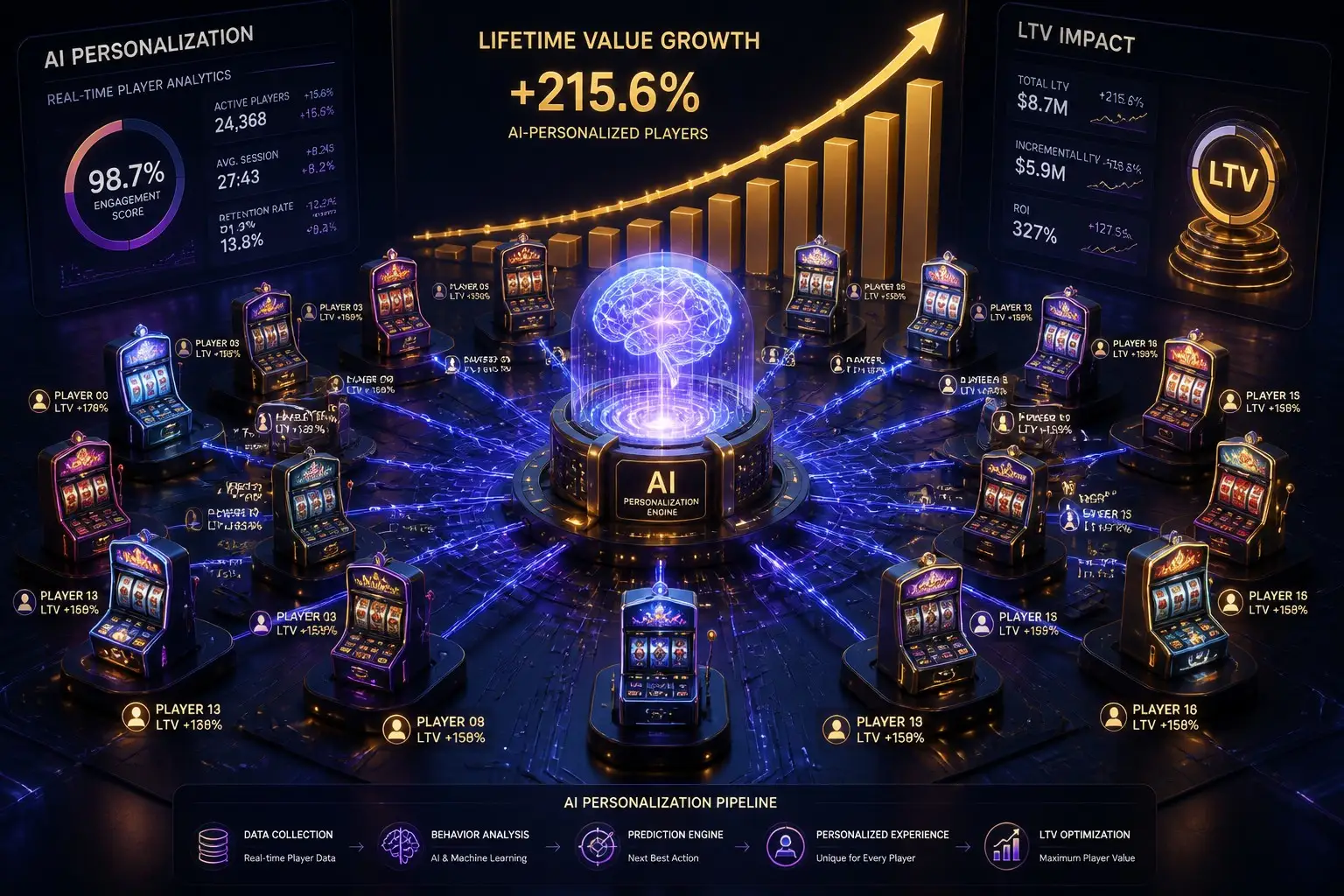
Across our 2026 partner deployments, engine-level AI personalization produced measurable results within 60 days:
- +31% average session duration compared to static-math control groups.
- +24% 90-day player retention for players in the personalized cohort.
- +18% average deposit frequency, driven by better-timed, feature-aligned bonus triggers.
- 18% reduction in churn rate at the 30-day mark.
Critically, these gains came with no increase in total promotional spend—the uplift is purely a function of smarter mathematical presentation.
Aligning Personalization with Protection
AI personalization is sometimes framed as the enemy of responsible gaming. At DYG, they are the same engine. The behavioral telemetry that personalizes the experience is the identical signal stream that feeds our player protection framework. When the system detects that a “personalized” flow is accelerating into harm—rather than engagement—the protection layer intervenes. This dual-use architecture ensures that LTV optimization never comes at the cost of player welfare.
Personalization Levers
- Volatility Curve Adaptation
- Feature Frequency Control
- Churn-Window Prediction
Measured LTV Impact
- +31% Session Duration
- +24% 90-Day Retention
- -18% 30-Day Churn
Market Context: Why LTV Became the Dominant Metric
The rise of LTV as the dominant growth metric in 2026 is a direct consequence of rising acquisition costs. In mature markets, cost-per-acquisition for a depositing player has climbed to levels that make customer acquisition unprofitable on a first-deposit basis. Operators have responded by shifting the growth calculus: if you cannot afford to acquire more players cheaply, you must extract more value from the players you already have. This is precisely the economic logic that elevates player lifetime value from a reporting metric to a strategic target.
Engine-level personalization attacks the LTV equation at its most fundamental point: the game session itself. Marketing personalization can improve the journey between sessions, but it cannot fix a session experience that does not fit the player. The behavioral telemetry that DYG’s engine uses is the same signal stream that reveals why players leave: a mismatch between the mathematical experience and the player’s psychological profile. A casual player subjected to high-volatility swings is not merely unlucky; they are experiencing a product that was not designed for them. Personalization corrects this at the source.
The market data supports the investment case. Across the broader online gaming sector in 2026, operators deploying session-level personalization report LTV improvements that consistently exceed the cost of implementation within a single fiscal quarter. The mechanism is compounding: longer sessions produce more behavioral data, which improves the personalization model, which extends sessions further. This data flywheel is the structural advantage that static-math competitors cannot replicate, regardless of their marketing sophistication.
There is also a competitive positioning dimension. As more operators adopt CRM-level personalization, the differentiation frontier moves deeper into the product. The operators who own the game-logic layer of personalization will define the next competitive standard; those who remain at the marketing layer will compete on diminishing returns. For B2B procurement teams, this argues for evaluating platform vendors on their engine-level personalization capability rather than their marketing integration partners.
Deployment Roadmap for Personalization
Rolling out engine-level personalization requires careful sequencing to protect the player experience and the licensed RTP. DYG guides operators through a three-stage deployment that has become the reference implementation across our 2026 partner network.
Stage 1: Observation-Only Mode
The personalization engine begins in observation mode, analyzing session behavior and computing the preferred profiles for every player without altering any outcomes. This stage typically runs for two weeks and produces two outputs: a segmentation map showing the distribution of player types across your base, and a projected impact model estimating the LTV uplift per segment. Operators use this period to align their bonus-budget teams on the expected changes.
Stage 2: Graduated Adaptation
Only the lowest-risk adaptation levers are enabled first: feature-frequency tuning and near-win pacing. Volatility-curve switching—the most sensitive lever—remains off until the team validates that the first stage improves engagement without affecting RTP variance tolerance. This staged approach protects the operator’s margin while building confidence in the system’s behavior.
Stage 3: Full Personalization and Measurement
With validation complete, all levers activate, and the analytics dashboard begins reporting the LTV metrics operators care about: session duration by cohort, 90-day retention, churn-window prediction accuracy, and deposit-frequency shifts. Because the engine shares its telemetry with the protection layer, operators can also demonstrate that personalization gains were not achieved at the expense of player welfare.
Frequently Asked Questions
How quickly do operators see LTV improvements after deployment?
The observation-only phase produces an immediate segmentation view, but the LTV improvements manifest progressively. Early indicators—session duration and feature engagement—typically show movement within the first two weeks of graduated adaptation. Full LTV effects compound over a 60-90 day window as the personalization models accumulate behavioral data and the retention flywheel engages. Operators who measure at the 90-day mark see the representative results.
Does personalization change the certified RTP?
No. The aggregate Return-to-Player for every title remains exactly at the certified value. Personalization shifts the psychological experience—win frequency, feature timing, pacing—within the bounds of the licensed math. Regulators auditing the titles see the same RTP certificates; players experience a journey tuned to their preferences.
Can players tell they are being personalized?
Most cannot, and that is by design. The goal is not to make sessions feel different from normal play, but to make the normal experience a better fit for each individual. The changes are subtle mathematical adjustments, not theatrical interventions. In our user research, players in the personalized cohort reported higher satisfaction without identifying any specific “trick.”
How is this different from standard CRM bonus segmentation?
CRM segmentation decides which promotional email or bonus a player receives. Engine-level personalization changes the game experience itself—volatility profile, feature frequency, pacing—in real time. The two layers are complementary: CRM works between sessions, personalization works inside them. Operators running both report the strongest LTV results.
What happens to data generated during personalization?
All behavioral telemetry flows through the same pseudonymized, retention-limited data pipeline described in our data-sovereignty framework. Personalization profiles are stored as tokens, not identities, and are subject to the same 90-day anonymization policy, ensuring LTV optimization never conflicts with privacy regulation.
Conclusion: Personalization Is the Growth Engine
In a $143 billion market, the difference between a growing operator and a stagnant one is increasingly defined by mathematical intelligence. AI personalization turns the game engine into a growth engine—adapting to each player, extending their journey, and protecting them along the way. DYG delivers this capability as a certified, auditable, and measurable part of the backend. The question is not whether personalization works; the data is settled. The question is whether your platform is ready to deploy it.
See the LTV data for yourself. Request a case-study briefing from DYG’s analytics team today.