
Executive Summary
In 2026, leading iGaming aggregators and Tier-1 multi-brand operators manage catalogs exceeding 10,000 active slot, table, crash, and live dealer titles across dozens of third-party game studios. Managing and distributing over 50 Terabytes of high-definition graphical textures, Spine/DragonBones animations, WebP sprite sheets, localized soundscapes, and WebAssembly binaries to tens of millions of global mobile players presents severe infrastructure hurdles. Initial load times exceeding 5 seconds cause over 40% of players to bounce back to the casino lobby. Implementing igaming dynamic cdn asset delivery architectures—incorporating intelligent delta asset updating, Brotli compression, adaptive WebP/AVIF format negotiation, and tiered edge caching—slashes initial bundle sizes by 65% and guarantees sub-1.5 second game launches across all mobile networks.
Game Content Hub 3.0: Dynamic CDN Edge Caching & Delta Asset Delivery for 10,000+ Titles
The scale of content distribution in modern iGaming has reached unprecedented complexity. An enterprise casino lobby is no longer a collection of static Flash games hosted on a single web server; it is a dynamic content ecosystem serving tens of thousands of graphically rich HTML5 and WebGL titles to players across every continent. With rich 4K animations, multi-layered audio tracks, and complex bonus rounds, modern game bundles frequently exceed 30MB to 60MB in raw uncompressed assets. For players on cellular networks in emerging markets, downloading these heavy bundles creates painful loading delays that directly destroy conversion rates. Solving this at scale requires an enterprise igaming dynamic cdn asset delivery pipeline. At DYG Games, our digital content distribution network employs advanced asset packaging, delta updates, and multi-tier edge caching to deliver lightning-fast launches across our entire global gaming catalog.
The Mobile Performance Bottleneck: Why Game Bundles Choke
Analyzing player drop-off telemetry reveals a direct mathematical correlation between asset download time and player bounce rate:
| Initial Game Load Time | Mobile Player Bounce Rate | First-Session Turnover Impact | Infrastructure Bandwidth Cost |
|---|---|---|---|
| >8.0 Seconds (Unoptimized legacy) | 54.2% | -42.5% GGR Loss | High ($0.08 / load) |
| 4.0 – 6.0 Seconds (Standard CDN) | 28.7% | -18.0% GGR Loss | Moderate ($0.04 / load) |
| <2.0 Seconds (Dynamic Edge Hub 3.0) | <4.5% | +24.0% GGR Baseline Lift | Optimized ($0.01 / load) |
Architecture of the Content Hub 3.0 Pipeline
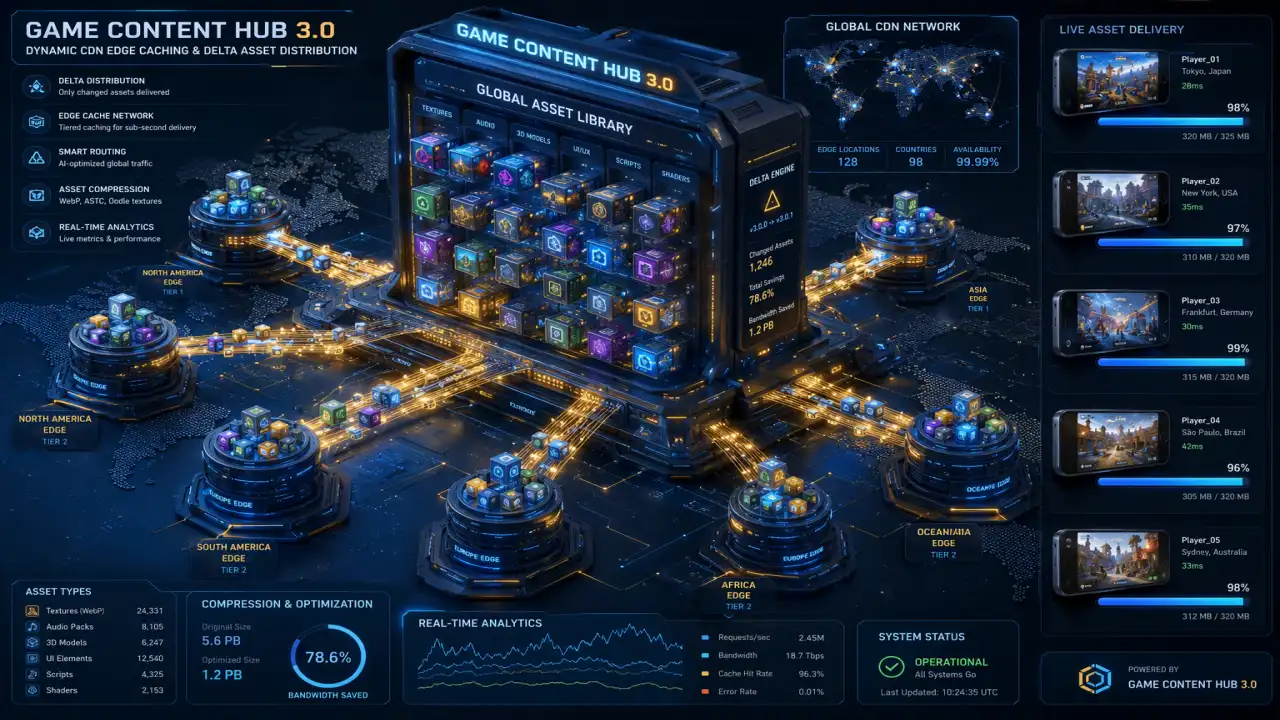
A production-grade game asset distribution network splits asset delivery into three decoupled optimization phases:
1. Progressive Asset Staging & Micro-Bundling
Rather than forcing the client to download the complete 40MB game package prior to displaying the first frame, modern game engines use progressive micro-bundling:
- Phase 1: Critical Shell (<1.2MB): Core HTML5 loader, WebGL canvas framework, base UI textures, and basic reel spin sounds. Loads in <600ms, displaying an active spin-ready state immediately.
- Phase 2: Base Game Assets (<3.5MB): High-resolution symbol sprite sheets, win animations, and ambient music streams downloaded in the background during the player’s first 3 spins.
- Phase 3: Bonus Round On-Demand Streaming (<8.0MB): Heavy cinematic cutscenes, 3D boss models, and bonus round audio assets downloaded opportunistically in the background—completely transparent to the user.
2. Intelligent Format Negotiation at the CDN Edge
Edge nodes dynamically inspect the client’s `Accept` headers and device screen resolution, transforming assets on the fly:
- Adaptive Image Transcoding: Automatically serving next-gen AVIF or WebP sprite sheets to compatible mobile browsers, reducing texture payload sizes by 40%–60% compared to legacy PNGs.
- Audio Transcoding: Serving highly compressed Opus audio streams for mobile cellular clients and AAC/MP3 fallbacks for older devices.
- Brotli Level-11 Compression: Compressing all JSON paytables, Spine animation skeletons, and WebAssembly binaries with Brotli compression at edge ingress.
3. Delta Updates & Incremental Asset Patching
When game studios release game updates (e.g., seasonal themes, promotional tournament banners, or localized text string adjustments), pushing an entire new 30MB bundle invalidates all client browser caches. Content Hub 3.0 deploys Binary Delta Patching (VCDIFF / HDiffPatch):
// Client Delta Patch Request Flow
GET /cdn-bundles/dyg_slot_olympus/v2.1.patch
If-None-Match: "hash_v2.0_bundle"

// Edge Worker returns binary delta (e.g., 85 KB instead of full 28 MB bundle)
Content-Type: application/octet-stream
X-Patch-Algorithm: VCDIFF
The client-side loader applies the 85KB binary patch to its local IndexedDB cache in <15ms, eliminating redundant asset downloads and slashing CDN bandwidth costs by over 90%.
Multi-Tier Global CDN Edge Ingestion
To support multi-brand casino operators managing games from 100+ third-party studios, Content Hub 3.0 deploys a tiered origin architecture:
- Studio Ingestion Gateways: Game studios push versioned asset bundles to an S3-compatible central object storage bucket protected by cryptographic integrity checks.
- Global Regional Shield Caches: High-capacity mid-tier origin shields (located in US-East, EU-Central, and AP-East) absorb edge cache misses, preventing origin server overload during viral game launches.
- Anycast Edge Caching Nodes: Distributed across 300+ metropolitan edge locations globally, serving cached game assets with >98.5% cache hit ratios and <15ms Time to First Byte (TTFB).
Integrating with High-Performance Game Catalogs
Game portfolios built natively for progressive streaming, such as DYG Games’ mobile-first titles, feature optimized Spine animations, compact WebP textures, and modular audio bundles that guarantee instant launch responsiveness across budget smartphones and flagship devices alike.
Frequently Asked Questions (FAQ)
How does progressive asset loading handle players triggering bonus rounds immediately?
If a player triggers a bonus feature on their very first spin before background Phase 3 assets finish downloading, the engine prioritizes the bonus bundle stream over standard background assets, completing the download during the celebratory feature trigger animation.
What client-side storage technology caches game assets on mobile browsers?
Modern HTML5 game clients utilize the browser’s `IndexedDB` and `CacheStorage` APIs (via Service Workers), allowing assets to persist reliably across mobile browser restarts without being purged by standard RAM garbage collection.
How does Content Hub 3.0 manage multi-language asset bundles?
Text strings and localized voice-over audio files are decoupled from core graphical bundles. The client downloads only the single active language pack (typically <150KB) based on the operator’s user locale settings.
Can operators host game assets on their own custom CDN domains?
Yes. Content Hub 3.0 supports custom CNAME routing and SSL termination, allowing white-label operators to serve all game assets from their branded domains to maintain consistent domain authority and SEO posture.
Is dynamic CDN asset delivery compatible with native mobile apps (iOS/Android)?
Yes. Native WebView and React Native wrapper apps consume the exact same edge CDN endpoints, utilizing native local disk caching for even faster repeat launches.
Conclusion
In the high-stakes world of digital iGaming, load speed is the front door of player retention. By deploying igaming dynamic cdn asset delivery architectures powered by progressive micro-bundling, edge format transcoding, and binary delta patching, operators and content aggregators ensure that their entire 10,000+ game catalog launches instantly, reliably, and cost-effectively for players across the globe.
Discover more about modern game development and content distribution technology by exploring DYG Games’ official engineering insights.