

Executive Summary
In 2026, affiliate marketing remains the primary player acquisition channel for global iGaming operators, generating between 40% and 65% of all first-time depositors (FTDs). However, legacy client-side cookie tracking and pixel-based attribution have collapsed under aggressive third-party cookie phaseouts, browser privacy sandboxes (Apple ITP), and sophisticated affiliate fraud rings. Deploying a resilient, server-to-server (S2S) igaming affiliate tracking pipeline has become mission-critical. This comprehensive architecture blueprint examines high-throughput S2S postback mechanisms, deterministic mobile deep-linking pipelines, real-time NGR/GGR revenue share calculation engines, and automated fraud detection algorithms designed to prevent multi-accounting, cookie stuffing, and botnet CPA arbitrage.
The iGaming Affiliate Tracking Pipeline: Real-Time S2S Postbacks, Deep-Linking & Anti-Fraud
Player acquisition costs in regulated iGaming have soared over the past three years. With cost-per-acquisition (CPA) rates frequently surpassing $250 to $500 in competitive European, North American, and Latin American markets, operators cannot afford attribution inaccuracies or affiliate revenue leakage. Concurrently, privacy-preserving browser updates and mobile operating system restrictions have rendered traditional client-side JavaScript tracking pixels and 30-day cookie attribution obsolete. In 2026, high-performing gaming platforms rely on an enterprise-grade igaming affiliate tracking pipeline built entirely on server-side event streaming, cryptographic transaction hashing, and machine-learning fraud scoring. At DYG Games, our platform integration architecture is engineered to provide seamless attribution hooks, enabling operators and affiliate networks to track conversions with millisecond precision and zero data loss.
Why Client-Side Pixel Tracking Failed
Understanding the necessity of modern S2S architecture requires auditing the structural points of failure inherent in legacy affiliate tracking models:
- Intelligent Tracking Prevention (Apple ITP) & Privacy Sandboxes: Modern mobile and desktop browsers purge client-side cookies within 24 to 72 hours, resulting in up to 35% of legitimate multi-session affiliate conversions being falsely attributed to “Direct Organic” traffic.
- Ad-Blockers & DNS Sinkholing: Over 40% of digital casino players utilize browser ad-blockers or privacy-focused browsers (such as Brave) that aggressively block third-party tracking scripts.
- Cookie Stuffing & Click Flooding: Malicious affiliate networks inject invisible iframes or fire automated click requests to overwrite referral attribution tags right before a user organically converts.
- Incentivized Bot Traffic & CPA Arbitrage: Fraudulent publishers deploy automated headless browsers to generate fake registrations and micro-deposits, collecting high CPA bounties before disappearing.
The Modern Server-to-Server (S2S) Attribution Pipeline
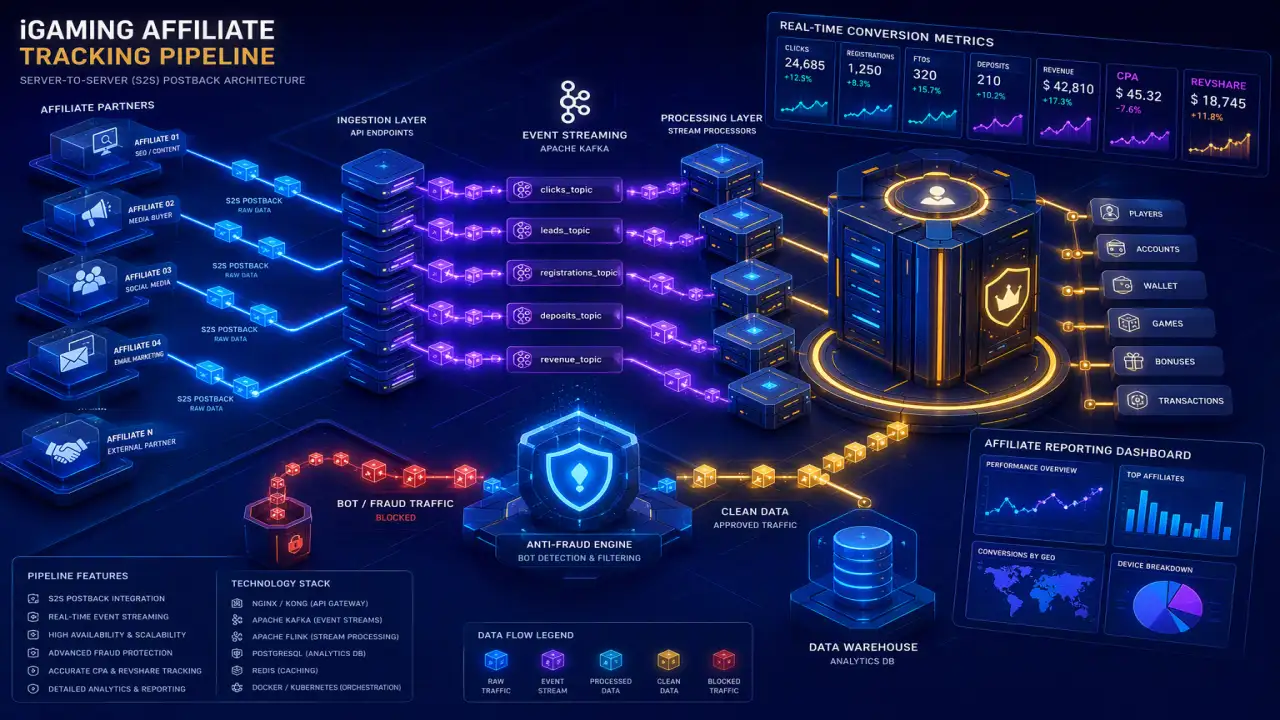
A production S2S affiliate tracking pipeline separates click capture, user identity resolution, and commercial event postbacks into resilient, high-throughput microservices.
1. Ingestion: Click Capture & Click-ID Generation
When a prospective player clicks an affiliate link on an external review portal, the request hits the operator’s high-speed edge proxy (e.g., Cloudflare Workers or AWS CloudFront). The edge worker extracts campaign parameters, sets a first-party, `HttpOnly`, `SameSite=Lax` cookie, and issues a cryptographically random, unique Click Identifier (`click_id`).
// Example Affiliate Click Envelope
{
  "clickId": "clk_9921820412891a",
  "affiliateId": "aff_partner_nordic_77",
  "campaignId": "cmp_slots_welcome_2026",
  "subAffiliateId": "sub_seo_review_p1",
  "landingUrl": "https://www.operator.com/games/olympus?click_id=clk_9921820412891a",
  "ipAddress": "185.220.101.42",
  "userAgent": "Mozilla/5.0 (iPhone; CPU iPhone OS 18_1)...",
  "timestamp": 1776330120150
}
2. Identity Binding on Registration
When the user completes registration, the PAM (Player Account Management) service binds the persistent `click_id` directly to the newly created internal `player_id` in the core database. This creates an immutable link between the player lifecycle and the acquiring affiliate partner that cannot be severed by browser cookie clears.
3. Real-Time Conversion Postback Dispatch
As the player triggers monetizable milestones (Registration, First Time Deposit / FTD, Subsequent Deposits, Qualified Turnover Thresholds), the event pipeline asynchronously fires an authenticated S2S HTTP webhook to the affiliate’s tracking platform (e.g., MyAffiliates, NetRefer, Everflow, or custom endpoints):
// Outbound S2S Postback Payload
POST https://tracking.affiliatenetwork.com/postback
Content-Type: application/json
X-Signature: sha256=9f83ab2c4e1...

{
  "click_id": "clk_9921820412891a",
  "event_type": "FTD",
  "player_id": "usr_anon_88219",
  "transaction_id": "tx_ftd_44921",
  "amount": 100.00,
  "currency": "EUR",
  "payout_cpa": 250.00,
  "timestamp": 1776330450000
}| Tracking Stage | Architecture / Protocol | Latency Target | Data Loss Rate |
|---|---|---|---|
| Click Ingestion | Edge CDN Proxy + First-Party Cookie | <15ms | <0.01% |
| Identity Resolution | PAM Postgres / Redis Primary Key Binding | Sub-millisecond | 0.00% |
| S2S Postback Delivery | Kafka Event Stream + Retry Queue (Dead Letter Queue) | <200ms | <0.001% (Guaranteed delivery) |
| Commission Calculation | Real-Time NGR Streaming Engine | Real-Time / Hourly | 0.00% |
Mobile Deep-Linking: Navigating App Stores to In-Game Action
A major challenge in mobile acquisition is routing players from an affiliate’s web review directly into a specific game title (e.g., launching directly into a popular slot or live table) rather than dumping them on a generic casino homepage. This requires Universal Links (iOS) and App Links (Android) coupled with deferred deep-linking engines (such as AppsFlyer or Branch):
- If the native app is already installed, the OS opens the app immediately, passing the affiliate token and deep-link URI directly to the game loader.
- If the app is not installed, the deferred link routes the user to the App Store, retaining attribution context across installation so that the first post-install launch navigates directly into the featured title.
Real-Time Anti-Fraud & Quality Scoring
High CPA bounties attract organized fraud syndicates. Modern affiliate pipelines incorporate automated quality scoring filters that evaluate conversions before approving payouts:
1. Multi-Account & Device Graph Analysis
The system evaluates browser canvas fingerprints, WebGL renderer hashes, IP subnet clustering, and device telemetry to detect single actors generating multiple synthetic player accounts across affiliate links.
2. Gameplay Depth & Velocity Scoring
Legitimate players exhibit natural gameplay dispersion (exploring multiple games, adjusting bet sizes, experiencing varied session lengths). Fraudulent CPA botnets typically follow rigid scripted paths: deposit minimum qualifying amount (e.g., €20), execute minimum spins at micro-stakes, and immediately abandon the account. Machine learning models score player turnover velocity, flagging anomalous traffic for automated commission holdbacks.
Commercial Commission Models: RevShare, CPA & Hybrid
The affiliate calculation engine must support multi-tier commercial agreements without manual spreadsheet reconciliation:
$$\text{NGR} = \text{Gross Bets} – \text{Wins} – \text{Bonus Costs} – \text{Admin/Platform Fees} – \text{Taxes/Levies}$$
$$\text{Affiliate Commission} = (\text{NGR} \times \text{RevShare \%}) + \text{CPA Bonus}$$
Leading content portfolios, such as DYG Games’ high-conversion title catalog, provide granular game-category reporting hooks, enabling operators to deduct precise game supplier fees and deliver transparent, dispute-free commission statements to affiliate partners.
Frequently Asked Questions (FAQ)
What is the difference between S2S postbacks and pixel tracking?
Pixel tracking executes via the user’s browser, making it vulnerable to ad-blockers, cookie purging, and network dropouts. S2S postbacks occur directly between the operator’s server and the affiliate’s server, guaranteeing 100% reliable tracking independent of client browser settings.
How does S2S tracking comply with GDPR and user privacy laws?
S2S tracking uses anonymized `click_id` tokens rather than personally identifiable information (PII). No personal data (such as player names, email addresses, or banking details) is ever transmitted in affiliate postback payloads.
Can affiliates manipulate S2S postbacks to claim unearned commissions?
No. Postbacks are triggered exclusively by the operator’s verified internal financial settlement events and signed with cryptographic HMAC tokens. Affiliates have no ability to inject or forge conversion events.
How are negative carryover and high-roller wins handled in RevShare?
Advanced tracking pipelines allow operators to configure negative carryover policies per affiliate contract. If a player wins a massive jackpot resulting in negative NGR, the engine isolates the negative balance according to contractual terms without disrupting standard account payouts.
Does S2S tracking slow down game loading times?
No. All affiliate tracking and postback dispatches operate asynchronously in background event streams (via Kafka/Redis), adding zero latency to the player’s front-end gaming session.
Conclusion
In an increasingly competitive and privacy-constrained digital landscape, maintaining a high-performance igaming affiliate tracking pipeline is the bedrock of profitable player acquisition. By transitioning to server-to-server postbacks, mastering mobile deep-linking, and enforcing automated anti-fraud quality scoring, operators safeguard their marketing investments and foster high-trust relationships with top-tier affiliate partners.
Discover more about modern platform engineering and player acquisition strategies by visiting DYG Games’ official engineering insights.