

The first generation of GDPR compliance was, frankly, superficial: a consent banner, a cookie notice, a privacy policy. The regulatory and judicial evolution since has rendered that approach obsolete. GDPR 2.0 and its international analogues now enforce data minimization by design, cross-border transfer restrictions with real teeth, and—increasingly—algorithmic transparency for automated decision-making. For online gaming operators, this means player data sovereignty must be engineered into the platform, not bolted on afterward. This is the compliance problem DYG’s 2026 data stack was built to solve.
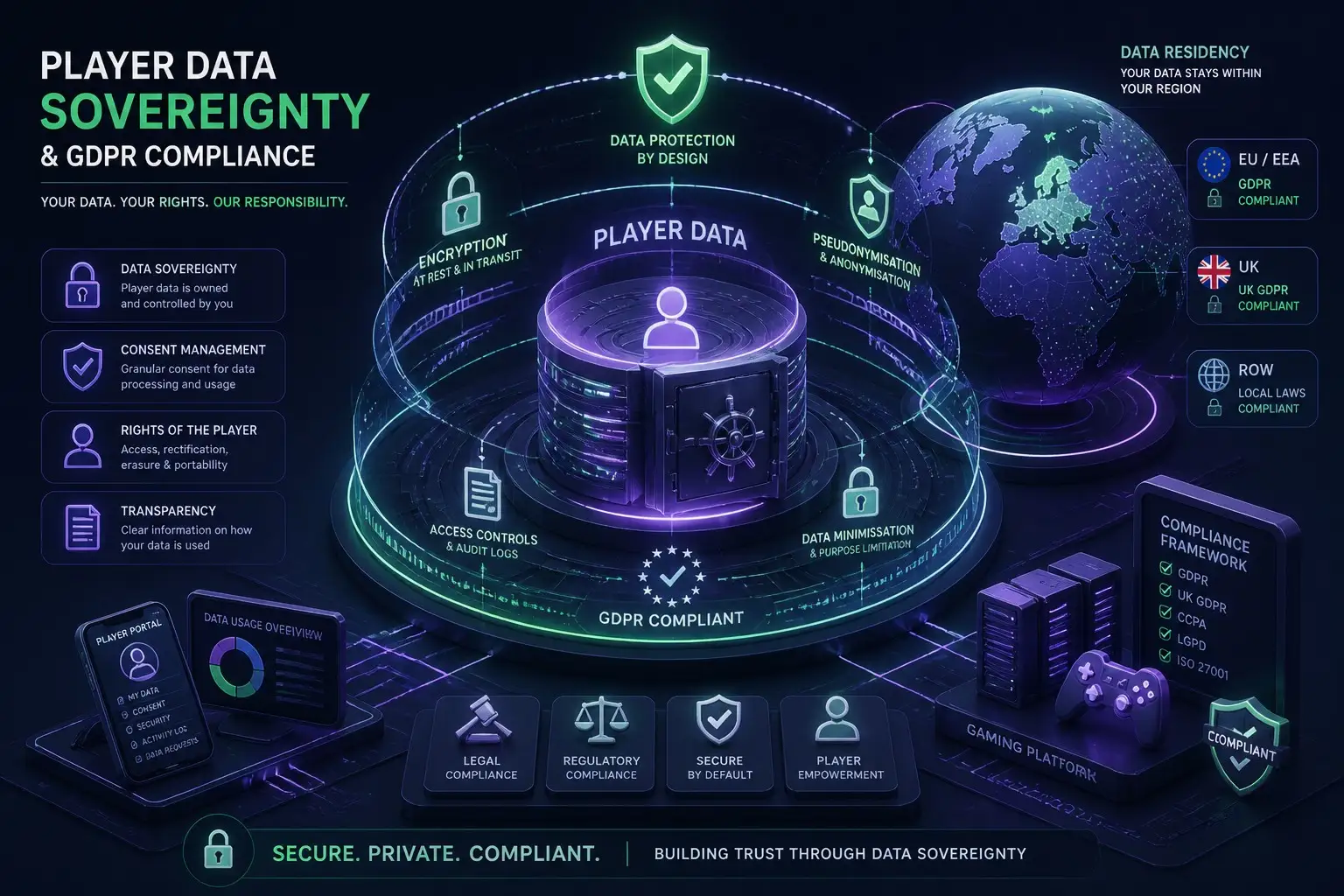
What Changed: From GDPR 1.0 to GDPR 2.0
- Data Minimization by Architecture: Collecting less data is no longer a recommendation; processors must demonstrate that data flows are minimized at the architectural level.
- Transfer Impact Assessments: Cross-border transfers face stricter scrutiny, with some regulators demanding region-local processing for sensitive player financial data.
- Algorithmic Transparency: Where AI personalization or risk-scoring affects players, operators must be able to explain the logic in human terms—a requirement that intersects directly with our AI personalization engine.
The DYG Data Sovereignty Stack
1. Region-Native Data Residency
Our architecture supports deployable data planes: player PII, wallet records, and session telemetry can be pinned to specific geographic regions (EU, LatAm, MENA) with independent encryption keys. The game logic remains centralized for consistency, but all regulated data stays local—satisfying data residency requirements without fragmenting the player experience.
2. Pseudonymization at the Edge
We push pseudonymization to the ingestion layer. Raw identifiers are replaced with rotating tokens before telemetry leaves the edge node, so the analytics and personalization layers operate on data that is useless to an unauthorized party. This is the same privacy-first philosophy we apply in our responsible gaming analytics.
3. Automated Rights-Pipeline
GDPR 2.0 sharpens the enforcement of access, erasure, and portability rights. DYG’s stack automates these processes: a player’s deletion request triggers a verifiable cascade across all data planes, game sessions, and backup systems, with a completion certificate returned to the operator for audit evidence.
Operationalizing Compliance: From Document to Dashboard
Compliance in 2026 must be observable. DYG provides operators with a live compliance dashboard showing: data residency coverage per region, active deletion requests and their processing status, transfer-impact assessments with expiration dates, and AI model governance logs. Regulators increasingly accept this level of demonstrable control as evidence of good-faith compliance.
The Business Case for Sovereignty Architecture
- License Protection: A data-sovereignty failure can suspend a license; the architecture prevents the failure class.
- Market Access: Region-native residency unlocks jurisdictions (like parts of LatAm and MENA) that require local processing.
- Brand Trust: Players increasingly choose platforms that demonstrate genuine data stewardship.
Sovereignty Stack
- Deployable Data Planes
- Edge Pseudonymization
- Automated Rights Pipeline
Operator Benefits
- Multi-Jurisdiction Readiness
- Audit-Ready Evidence
- License Risk Reduction
Industry Context: The Enforcement Reality
The enforcement landscape of 2026 has transformed data protection from a compliance exercise into an operational risk management discipline. Regulatory authorities across Europe and beyond are demonstrating a willingness to act, with fines and enforcement actions targeting not only data breaches but also systemic failures in data governance—including inadequate transfer mechanisms, excessive data retention, and opacity in automated decision-making. For gaming operators, whose business model depends on continuous processing of behavioral data, the exposure is substantial.
The intersection of data protection and artificial intelligence regulation adds a new layer of complexity. The EU AI Act’s risk classification and transparency requirements apply directly to the machine-learning systems that power personalization, risk-scoring, and fraud detection in gaming. An operator running an AI-based churn prediction model must now be able to document its data flows, model governance, and human-review processes. The operators who treat this as a documentation burden will struggle; those who treat it as a data-architecture requirement will thrive.
There is also a competitive dynamic at play. Data sovereignty has become a market-access criterion in several emerging jurisdictions. Regulators in parts of Latin America, the Middle East, and Asia are conditioning market entry on local data residency, and operators who cannot offer region-native processing are simply excluded from those growth markets. The architectural investment in deployable data planes is not merely a compliance hedge; it is a license to participate in the fastest-growing segments of the industry.
The strategic implication for B2B decision-makers is unambiguous: data governance capability is now a supplier-selection criterion on par with game quality and platform reliability. When evaluating platform vendors, procurement teams should demand evidence of region-native residency, automated rights pipelines, and AI governance tooling—not policy documents, but demonstrable technical capability. The vendors who deliver this will be the partners of choice for operators building for the next regulatory era.
Compliance Program Rollout: From Paper to Production
Building a data-sovereignty architecture is only half the journey; operationalizing it across the organization is the other half. DYG supports operators with a rollout program that turns compliance from a document exercise into a living capability.
Step 1: Data Flow Mapping and Gap Analysis
The rollout begins with a full data-flow map: every system that touches player data, every transfer between regions, every retention period. DYG’s compliance engineers work with your team to identify where data currently resides, where it flows, and where it violates the new residency or minimization requirements. The gap analysis output becomes the prioritized remediation roadmap.
Step 2: Architecture Remediation
With the roadmap in hand, the remediation phase deploys the technical controls: region-native data planes, edge pseudonymization, and the automated rights pipeline. Each control is configured against the specific regulatory profile of every jurisdiction the operator serves, ensuring that remediation is not generic but targeted to actual obligations.
Step 3: Governance and Continuous Auditing
The final phase institutionalizes compliance: the live compliance dashboard becomes the operating picture, the automated rights pipeline handles player requests end-to-end, and scheduled audits verify that controls continue to operate as designed. This is the state regulators increasingly expect—not a static policy but a demonstrably functioning system.
Frequently Asked Questions
What is the cost implication of the data sovereignty stack?
The incremental cost of deployable data planes is modest relative to the risk it mitigates. The architecture reuses the same infrastructure with regional configuration applied at the deployment layer, avoiding duplicated builds. The cost profile includes regional hosting, key management, and the automated rights pipeline—all operational expenses that scale predictably with player volume. Against the potential cost of a single enforcement action or license suspension, the architecture is a rational insurance investment.
How long does a full compliance architecture deployment take?
For an operator on DYG’s platform, the data sovereignty components deploy as part of the standard onboarding, typically adding one to two weeks to the integration timeline. The automated rights pipeline and compliance dashboard are configured during onboarding, with the live compliance view available from launch. Operators migrating from legacy stacks can expect a longer transition while existing data flows are mapped and remediated.
Does region-native data residency affect game performance?
No, because only regulated data (PII, wallets, telemetry) is region-pinned; game logic remains centralized or distributed for performance as needed. The data plane and the game plane are architecturally separated, so residency compliance does not introduce latency or fragment the player experience.
How do we handle players who travel between regions?
The platform treats residency by documented account location, not by momentary connection point. A player’s data plane is determined at account establishment and changes only through a controlled relocation process. This prevents the “where is this data now” ambiguity that complicates cross-border compliance.
What does the automated rights pipeline cover?
It covers access requests, rectification, erasure, and portability—each automated end-to-end with completion certificates. The pipeline handles both single-record requests and complex cascading requests across data planes, backup systems, and downstream processors, with full audit logging of every step.
What training do our teams need to operate the compliance stack?
DYG provides role-based training: compliance officers learn the dashboard and reporting workflows, engineering teams learn the data-plane configuration and rights-pipeline operations, and support teams learn the player-facing request handling. Training is delivered through documented playbooks and live sessions, typically completed within one week. Ongoing updates are communicated through the release notes and quarterly refresh sessions.
Can this stack handle AI governance requirements?
Yes. The EU AI Act’s transparency requirements intersect with GDPR 2.0’s algorithmic provisions, and DYG’s stack includes model-governance logging: which models processed which data, under what version, and with what human-review trail. This satisfies the “explainable AI” expectations now appearing in licensing frameworks.
Conclusion: Data Governance as Competitive Advantage
The operators who treat player data sovereignty as an architectural investment—rather than a compliance cost—will own the next decade of market access. GDPR 2.0 is not the end of data-driven gaming; it is the framework within which responsible operators win. DYG has engineered this framework into the platform: region-native, auditable, and player-first. Compliance is no longer what you file; it is what you run.
Future-proof your data architecture. Request DYG’s compliance engineering team for a sovereignty audit of your current stack.