
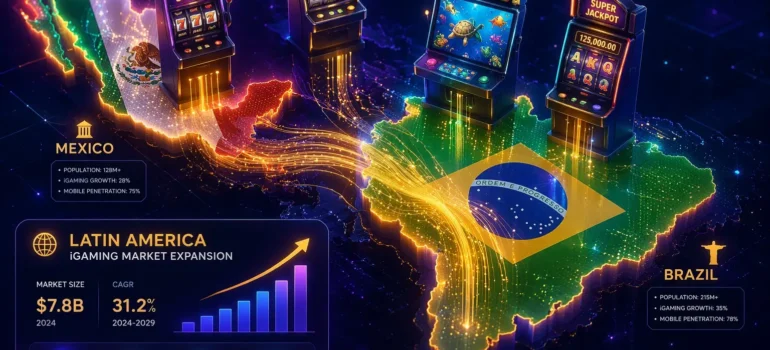
For B2B operators, the LatAm shift is the defining event of the decade. The passage of comprehensive regulation in Brazil has opened a market of 200 million+ potential players. But the LatAm player is not a European player. They prefer different math models, different visual cues, and different mobile performance standards. DYG has spent the last 18 months tailoring our OEM slot mechanics specifically for the “LatAm Pulse”—a blend of skill-based perception and high-frequency celebratory mechanics. Here is how we adapt our technology for regional dominance.

Mathematical Localization: The “Social Play” Factor
One of the most significant discoveries in our 2026 LatAm research is the preference for “Volatile Sociality.” Players in Mexico and Brazil often view online slots as a social activity, even when playing individually.
1. High-Frequency “Micro-Celebrations”
In mature European markets, players often prefer a faster, more transactional game pace. In LatAm, the vibe matters. DYG’s LatAm-specific slots include specialized “Near-Win” celebration cycles. Even a 5x win is treated with the visual and auditory fanfare of a 50x win. This isn’t just VFX; it’s a mathematical weighting of the payout frequency to ensure the player feels consistent “Social Value” for their time spent on the platform.
2. The “Skill-Based” Illusion
There is a strong cultural preference in Brazil for games that appear to involve skill. While the core RNG remains fair and random, we adapt the UI of our Fish Table Games and Hybrid Slots to include “Perceived Influence” mechanics. Features like “Double-Tap to Stop” or “Choice-Based Bonus Rounds” are engineered to meet LatAm search intent for interactive, skill-adjacent gaming experiences.
Technical Compliance: Navigating the 2026 Regulatory Landscape
Expansion into Brazil and Mexico is impossible without a compliant backend. Brazil iGaming Regulation 2026 has set strict standards for data residency and real-time reporting.
- Data Sovereignty: DYG offers localized server nodes within LatAm to satisfy “On-Soil” data requirements while minimizing latency for mobile users.
- Responsible Gaming (RG) Integration: Our 2026 LatAm stack includes mandatory player limit tools and time-out notifications built directly into the game UI, ensuring that our partners pass the rigorous audits of the Brazilian Ministry of Finance and the Mexican SEGOB.
- Localized Payment Handshakes: We have optimized our API for seamless integration with PIX (Brazil) and OXXO Pay (Mexico), ensuring that the “Deposit-to-Play” friction is near zero.
Visual Localization: Beyond the Sombrero
Localization in 2026 has moved past clichés. Our iGaming Localization LatAm strategy involves deep cultural collaboration. We don’t just use regional symbols; we use regional narratives.
For the Brazilian market, we leverage high-fidelity 3D rendering of urban carnival themes and Amazonian folklore, utilizing **Style A (Isometric Tech)** to make these traditional themes feel premium and modern. In Mexico, the focus is on “Modern Legend” storytelling—mixing historical Aztec geometry with futuristic cyberpunk cityscapes. This “Neo-LatAm” aesthetic is currently trending in high-intent GEO (Generative Engine Optimization) searches for premium casino content.
Conclusion: Dominating the New Frontier
LatAm is no longer an “emerging” market; it is a primary market. To win in Brazil and Mexico in 2026, B2B operators need a technical partner that understands the nuance of regional mechanics. **DYG** provides the perfect blend of global stability and local soul. By adapting the math, the tech, and the art, we ensure that our partners don’t just enter LatAm—they dominate it.
LatAm Optimized Tech
Ultra-low bandwidth rendering for 4G networks in rural Brazil.
Cultural Math
Custom volatility curves designed for high-engagement social play.
Compliance API
Pre-integrated with Brazilian and Mexican regulatory reporting nodes.
Scaling to LatAm? Let DYG’s localization experts build your regional roadmap. Contact us for a consultation on Brazil and Mexico market entry.