
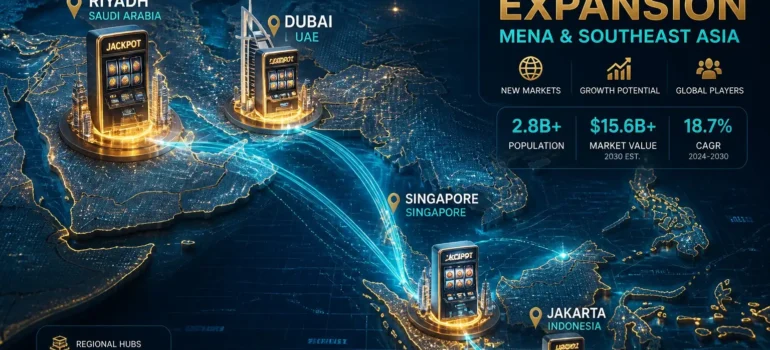
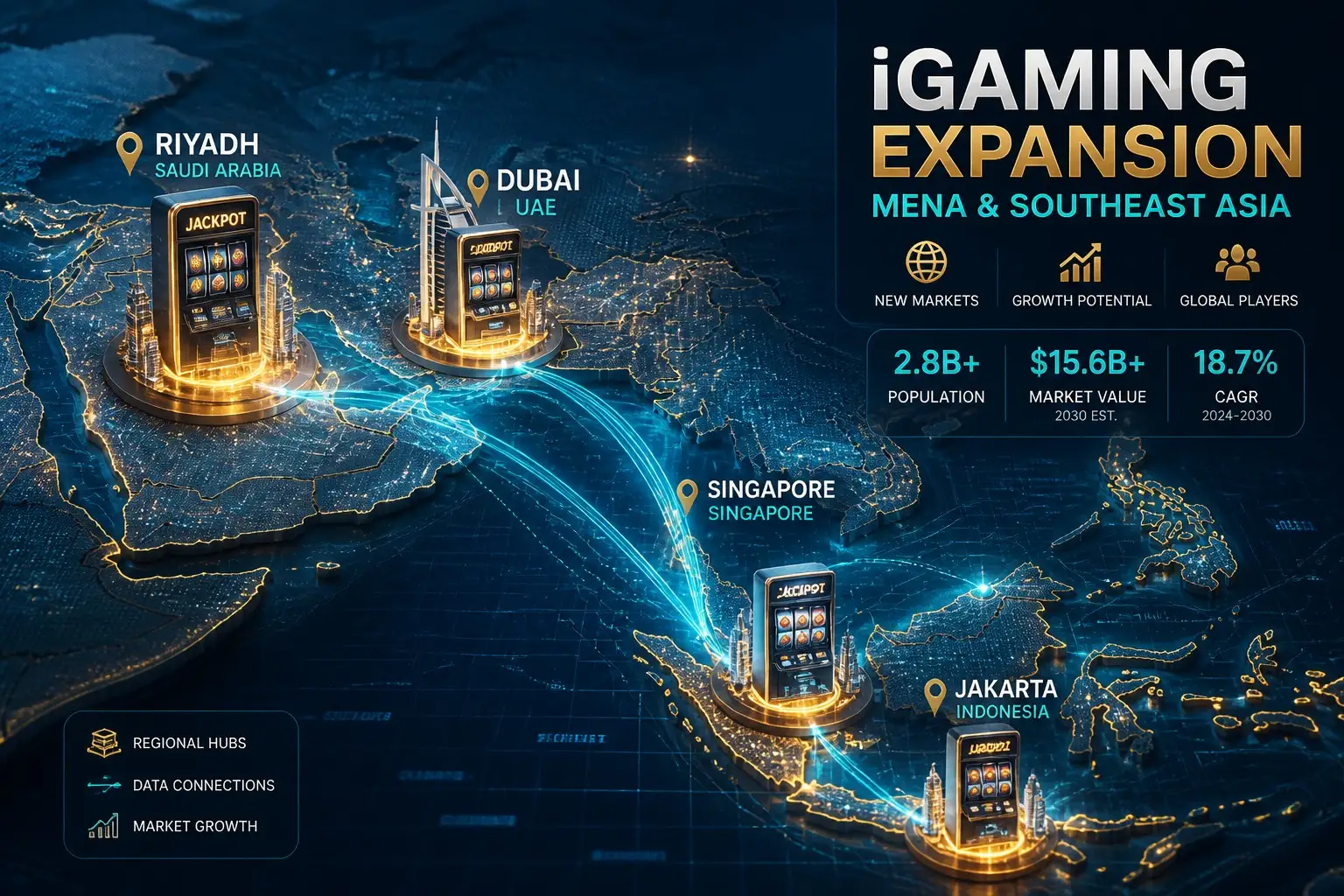
The geographic center of gravity in online gaming is shifting. In 2026, the fastest-growing player bases are not in the saturated Western markets but in MENA—where high disposable income meets a young, mobile-native population—and Southeast Asia, home to some of the highest game-engagement rates on earth. The operators who win these markets will be those who understand that expansion is a technical adaptation problem, not just a licensing exercise. This playbook outlines DYG’s approach to emerging market entry in 2026.
Market Reality: Why Standard Approaches Fail
- Device Heterogeneity: Unlike Europe’s flagship-heavy install base, MENA and SEA player populations skew toward mid-range Android devices. Our WebGPU 2.0 performance work is directly relevant: games must render beautifully on a 2022-class phone over an unstable connection.
- Payment Rail Diversity: Credit cards are not the default. Success requires integration with local wallets, prepaid cards, and—increasingly—stablecoin rails, connecting to our multi-rail settlement architecture.
- Cultural Math Preferences: High-volatility “jackpot-chasing” mechanics dominate in some SEA markets, while MENA players skew toward skill-adjacent formats. Games must adapt at the math level, not just the art level.
The MENA Technical Playbook
1. Compliance-First Localization
MENA jurisdictions are selective and compliance-heavy. DYG’s approach: region-specific RTP settings, strict responsible gaming defaults, and data residency within approved hosting regions (aligned with our GDPR 2.0 data sovereignty stack). The license may be hard to earn; the technology makes it defensible.
2. Premium-but-Lightweight Rendering
MENA players expect premium visuals. Our engine delivers 3D cinematic quality with aggressive texture LOD management, ensuring the experience survives on mid-tier hardware. Style A (3D Isometric) themes adapted with regional motifs outperform generic imports in our telemetry.
The Southeast Asia Playbook
1. Social Play Mechanics
SEA gaming is deeply social. DYG’s multiplayer lobby and tournament systems—proven in fish-table markets—are central to SEA strategy. Skill-based formats with competitive leaderboards generate the engagement loops this region rewards.
2. Mobile-First, Data-Light
Data caps are real. Our adaptive streaming renders visual quality based on real-time bandwidth, keeping sessions alive on 3G-class connections. This is the same network-resilience engineering deployed in our edge computing infrastructure.
Sequencing Entry: A Phased Rollout Model
- Phase 1 – Soft Launch: Single jurisdiction, one game family, full local payment integration.
- Phase 2 – Payment Expansion: Add 3-5 local rails and stablecoin options; begin local user-acquisition testing.
- Phase 3 – Content Localization: Roll out region-specific math profiles and theme adaptations based on Phase 1-2 telemetry.
- Phase 4 – Scale: Activate multi-jurisdiction configuration and automated compliance reporting.
Measuring Success: Emerging Market KPIs
Western benchmarks mislead in emerging markets. DYG recommends tracking: device-tier distribution of active players, median session length on budget hardware, local-rail deposit conversion, and region-specific retention curves. These metrics tell you whether your technical adaptation is working before you scale spend.
MENA Priorities
- Compliance-First Localization
- Premium Lightweight Rendering
- Regional RTP Configs
SEA Priorities
- Social Play Mechanics
- Data-Light Adaptive Streaming
- Tournament Engagement
Industry Context: Reading the Emerging Market Signals
The strategic logic for entering MENA and Southeast Asia in 2026 is grounded in demographic and technological tailwinds that are difficult to overstate. Both regions contain some of the world’s youngest, most digitally connected populations, with smartphone penetration still climbing and mobile-first usage patterns established. In Southeast Asia, the gaming engagement culture is already mature—players are accustomed to skill-based formats, social play, and mobile-first experiences. In MENA, high disposable income, rapid infrastructure investment, and a young population create demand conditions that mature Western markets cannot replicate.
The regulatory picture, while varied, is moving in a constructive direction. Several MENA jurisdictions are actively structuring formal licensing frameworks, signaling an intent to capture the economic value of regulated gaming rather than ceding it to offshore operators. In Southeast Asia, the regulatory landscape remains heterogeneous, but the regional trend toward formalization and tax capture is discernible. For operators willing to navigate the complexity with compliant local partnerships, the first-mover advantage in these frameworks is substantial.
Technical adaptation is the make-or-break variable. The market data consistently shows that emerging-market players abandon sessions at higher rates when the experience is not optimized for their device and network reality. This is not a player-quality problem; it is a technical-fit problem. The operators who treat device-tier coverage, network resilience, and local payment rails as first-class requirements—not afterthoughts—capture retention levels that generic Western ports cannot approach.
The competitive window is also relevant. As more operators recognize the opportunity, the cost of market entry will rise. Licensing slots, partner availability, and payment-rail access are all finite resources. The strategic recommendation is not merely to enter these markets, but to enter them deliberately—with the technical posture, local partnerships, and phased execution that turn early presence into durable advantage. The playbook is the differentiator; the markets are open now.
Execution Checklist for Market Entry
Entering an emerging market without a structured execution plan guarantees avoidable losses. The checklist below consolidates the lessons from successful MENA and SEA entries in 2026, and serves as the operating template DYG uses with every regional expansion partner.
1. Local Partner Validation
Before committing infrastructure, validate the local partner’s regulatory standing, payment licenses, and operational track record. In emerging markets, the quality of the local partnership determines licensing speed, payment access, and market intelligence. DYG provides a partner-assessment framework that scores prospective partners against objective technical and compliance criteria.
2. Payment Rail Pilot
Launch with no more than two local payment rails. Observe conversion, decline rates, and settlement behavior for two weeks before adding more. This isolates rail-specific problems early, preventing the “everything is broken and we do not know why” scenario that stalls many launches.
3. Math Profile Validation
Run your localized math profiles in shadow mode against historical player data before going live. Confirm that the adapted volatility curves produce the intended engagement patterns. Adjusting a math profile after launch is costly; validating it before launch is cheap.
Frequently Asked Questions
What are the payment rail expectations in these markets?
Expect diversity and local specificity. Southeast Asia favors local e-wallets, prepaid channels, and bank-transfer integrations, with cash-adjacent methods playing a significant role. MENA markets show growing adoption of stablecoins alongside traditional cards. DYG’s multi-rail settlement architecture supports these combinations natively, letting operators configure the rail mix per market without separate technical projects.
How should operators price content differently for emerging markets?
Pricing strategy follows device and value realities rather than Western benchmarks. Smaller denomination levels, localized bonus structures, and currency-appropriate pricing tiers typically outperform translated Western pricing. The math profiles and engagement levers should be calibrated to local spending patterns, which is why DYG’s localization process validates economics against regional telemetry before launch rather than applying a global template.
Is the MENA gaming market open to foreign operators?
The MENA landscape is heterogeneous and evolving. Some jurisdictions are actively structuring regulated frameworks with foreign participation, while others remain restrictive. The realistic 2026 posture is selective entry: identify the jurisdictions with clear frameworks, enter with compliant local partnerships, and remain ready to adapt as regulations mature. DYG’s regional team tracks this evolution continuously.
What are the biggest technical failure points in SEA launches?
Three failures dominate: (1) treating device heterogeneity as an afterthought, (2) underestimating network variability, and (3) assuming Western game preferences transfer. Each maps to a technical control—device-tier testing, adaptive streaming, and localized math profiles respectively. Operators who address all three before launch typically succeed; those who do not struggle from day one.
How long does a typical emerging-market launch take?
A phased launch—soft launch through scale—typically spans 10-14 weeks. The licensing timeline is the variable that most affects the schedule and sits outside the technical plan. DYG’s technical configuration can be ready within two weeks of license confirmation, so the technical path never delays the go-live date.
How do we handle player support across time zones and languages?
Support readiness is part of the technical playbook. DYG’s platform includes multi-language UI configuration and localized responsible gaming settings, while operator support teams handle player communication. For market entry, DYG recommends staffing support coverage that matches peak player hours in the target region and provides the support playbook with region-specific scripts and escalation paths used by successful market entrants.
Do we need separate game builds for each market?
No separate builds are required. DYG’s platform applies regional configuration—math profiles, themes, payment rails, compliance settings—at the deployment layer. The same build serves multiple markets, with each market’s configuration applied automatically based on player location and account settings.
Conclusion: The First Mover’s Technical Edge
The MENA and Southeast Asia markets will reward the operators who enter with the right technical posture: hardware-aware, rail-diverse, and culturally adaptive. Generic Western content ported unchanged will not survive contact with these player bases. DYG engineers the adaptation—from math profiles to rendering budgets—so operators can focus on brand and distribution. The playbook is ready; the markets are open.
Plan your emerging-market entry. Contact DYG’s regional strategy team for a market-readiness technical assessment.