
Executive Summary
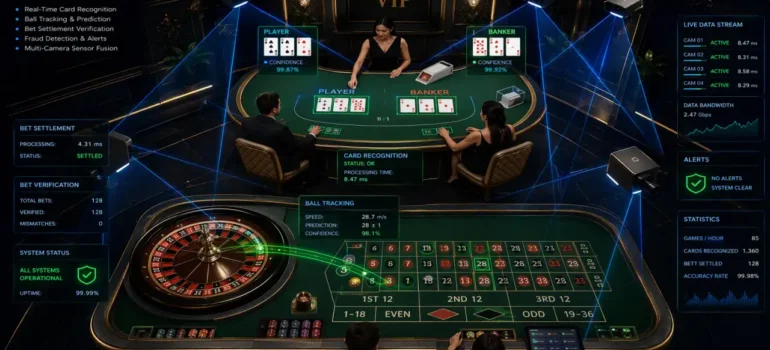
In 2026, the global live dealer casino market is undergoing a fundamental technological overhaul driven by deep learning and edge computing. Migrating away from fragile, high-maintenance RFID physical sensor shoes and manual dealer barcode scanners, modern live studios are adopting multi-camera live casino computer vision ocr architectures. By processing 120 FPS high-definition studio camera feeds directly on edge GPUs with specialized convolutional neural networks (CNNs) and transformer models, live casino engines achieve sub-20ms card recognition, instant roulette pocket localization, and real-time dice face classification with >99.998% accuracy. This technical blueprint breaks down the end-to-end computer vision pipeline, WebRTC sub-second streaming synchronization, automated dispute resolution replay logs, and multi-region CDN encoding strategies required to deliver flawless live dealer experiences to thousands of simultaneous players worldwide.
Computer Vision in Live Casino: Optical Card Recognition & Millisecond Bet Resolution
The live casino vertical has long been the highest-yielding yet most operationally complex segment of online gaming. Combining physical studio operations with digital real-time wagering requires flawless synchronization between the physical dealer’s actions and the digital bet settlement engine. Historically, studios relied on mechanical scanner shoes, manual barcode readers, and embedded RFID chips in playing cards and chips. However, physical sensors are prone to wear, expensive to replace, vulnerable to dealer occlusion, and introduce noticeable friction into game flow. In 2026, the gold standard of live dealer engineering is live casino computer vision ocr. At DYG Games, our live casino R&D teams have pioneered neural optical recognition systems that turn standard 4K studio cameras into real-time, tamper-proof state machines capable of settling thousands of player bets in milliseconds.
The Limitations of Legacy Hardware Sensors vs. Neural Vision
Physical sensor hardware in live studios introduces recurring operational overhead and systemic vulnerabilities that modern computer vision architectures completely eliminate:
| Dimension | Legacy RFID / Barcode Hardware | AI Computer Vision & Neural OCR (2026) |
|---|---|---|
| Consumables Cost | High ($15–$35 per RFID/Barcode deck, replaced every 4–8 hours) | Zero (Uses standard casino-grade paper or plastic decks, $2–$4/deck) |
| Recognition Latency | 250ms – 600ms (Physical optical swipe / RFID read buffer) | 12ms – 25ms (Edge TensorRT inference on GPU) |
| Hardware Maintenance | Frequent shoe calibration, laser lens cleaning, sensor drift | Overhead camera mount; zero physical table wear points |
| Roulette & Dice Coverage | Requires specialized electronic rims and laser tripwires | Unified visual tracking of ball trajectory, rotor velocity, and dice faces |
| Dispute Auditability | Log files with no frame-by-frame visual overlay correlation | Frame-accurate bounding box video recording synchronized with game logs |
The End-to-End Neural Vision Pipeline
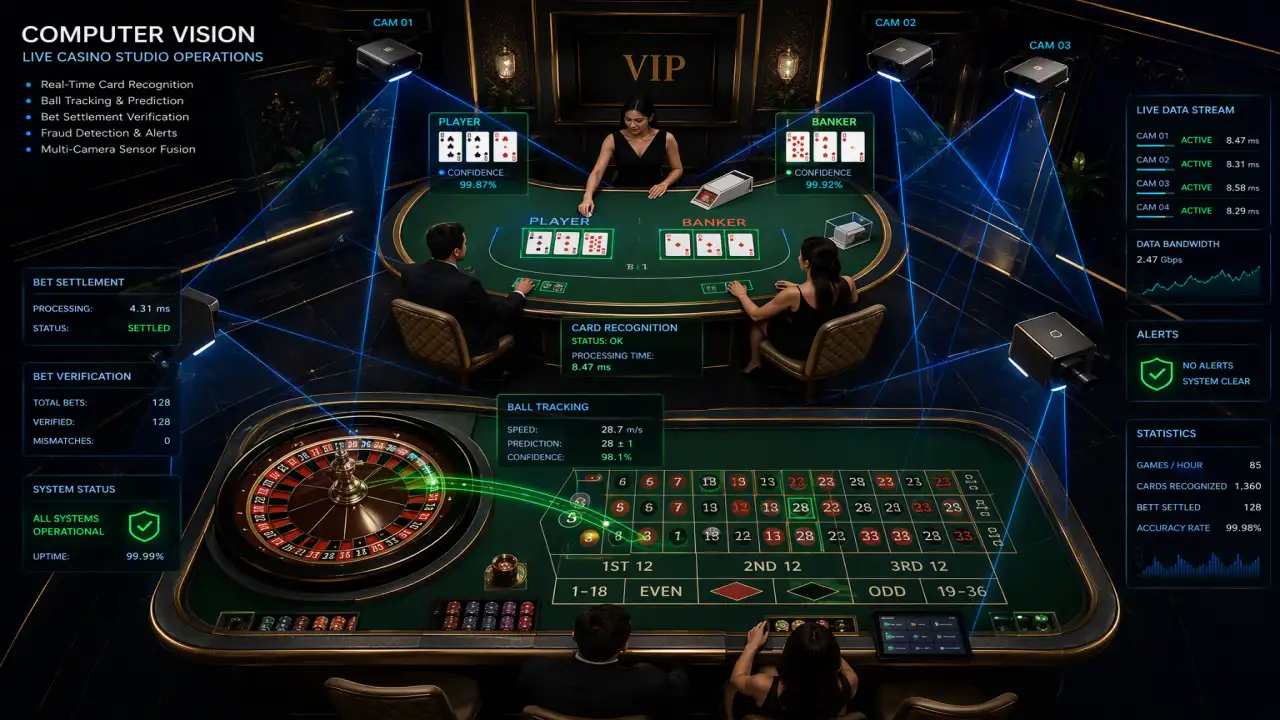
Executing real-time computer vision in live dealer environments requires a multi-stage pipeline running on dedicated edge compute nodes (e.g., NVIDIA Jetson AGX Orin or rackmount RTX GPUs) located within the studio facility.
1. High-Frame-Rate Video Ingestion
Overhead and angled studio cameras capture table activity at 1080p/4K resolution at 120 frames per second over low-latency SDI or GigE Vision interfaces. High frame rates eliminate motion blur during rapid card dealing, ball spins, or dice shakes.
2. Region of Interest (ROI) Dynamic Segmentation
Rather than running heavy neural models across the entire 4K frame, lightweight segmentation algorithms identify dynamic Regions of Interest (such as the Player/Banker card dealing zones in Baccarat or the active betting layout in Blackjack). This reduces computational overhead by over 75%.
3. Multi-Task Deep Learning Inference
Specialized lightweight neural networks execute in parallel:
- Card Value & Suit Classifier (OCR): A customized YOLOv10/MobileNet-V4 architecture trained on millions of synthesized card variations (handling bent corners, partial dealer finger occlusions, reflections, and shadow gradients). Inference executes in <8ms per card with >99.998% accuracy.
- Roulette Ball Trajectory & Pocket Localization: High-speed object tracking models monitor ball deceleration, wheel rotor angular velocity, and final ball resting position, predicting and confirming winning numbers within 300ms of ball capture.
- Sic Bo / Craps Dice Recognition: 3D pose estimation and top-face dot counting algorithms that resolve dice outcomes instantly through clear shaker domes.
4. State Machine Validation & Game Engine Dispatch
Raw visual classifications pass to a deterministic Game Logic State Machine. The state machine verifies that the recognized card adheres to legitimate deck composition (preventing impossible duplicate cards) and conforms to jurisdictional game rules before pushing the outcome to the RGS bet settlement worker over internal gRPC channels.
// Example Computer Vision State Event Payload (gRPC JSON)
{
  "tableId": "live_baccarat_vip_04",
  "roundId": "rnd_20261016_994120",
  "frameTimestamp": 1776329820112,
  "confidenceScore": 0.99984,
  "detectedState": {
    "gameType": "BACCARAT",
    "playerHand": [
      {"rank": "KING", "suit": "SPADES", "bbox": [412, 620, 510, 780]},
      {"rank": "9", "suit": "HEARTS", "bbox": [520, 620, 618, 780]}
    ],
    "bankerHand": [
      {"rank": "JACK", "suit": "DIAMONDS", "bbox": [710, 620, 808, 780]},
      {"rank": "7", "suit": "CLUBS", "bbox": [818, 620, 916, 780]}
    ],
    "outcome": "PLAYER_NATURAL_9_WIN"
  }
}
Sub-Second Video Streaming & UI Synchronization (WebRTC)
A flawless player experience requires exact synchronization between the video stream seen on the player’s screen and the digital betting interface. If bet resolution notifications arrive before the dealer is seen revealing the physical card, player immersion and trust collapse.
1. WebRTC & Low-Latency HLS (LL-HLS)
Modern live casino architectures stream video over WebRTC with sub-250ms glass-to-glass latency globally. Video streams are encoded with AV1 or HEVC codecs using variable bitrate (VBR) adaptation to maintain high visual fidelity on unstable mobile connections.
2. NTP Timestamp Synchronization
Each video frame embeds an encoded timecode (SEI metadata). When the game client renders frame $T$, it matches the visual frame to the incoming WebSocket state packet with timestamp $T$, guaranteeing that digital chip animations, highlight glow effects, and balance updates coincide perfectly with the dealer’s physical movements.
Automated Dispute Resolution & Fraud Prevention
Human dealer errors (such as misdeals, drawing out of sequence, or placing cards in the wrong betting box) cost live studios thousands of dollars in lost player confidence and manual supervisor review time. Computer vision solves this through active automated monitoring:
- Instant Misdeal Alerts: If a dealer attempts to draw a third card when rules dictate a Banker stand, the vision system flashes an immediate audio-visual alert on the dealer’s private prompter screen, pausing the round before a wrongful outcome occurs.
- Frame-Accurate Video Replay Logs: Every resolved round generates an indexed video snippet bounding box file stored in immutable cloud storage. In the event of a player dispute, supervisors inspect the exact neural detection coordinates in seconds rather than scrubbing through hours of CCTV footage.
- Card Counting & Collusion Telemetry: In Blackjack, the vision engine maintains real-time shoe penetration and running true-count telemetry, cross-referencing high-stakes bet spreads against card count metrics to detect advantage play rings automatically.
Integrating Live Content with Core RGS Platforms
Live dealer feeds are most effective when seamlessly unified with RNG slot and table content. Platforms powered by DYG Games’ modular RGS framework allow operators to serve live casino streams alongside integrated promotional widgets, shared multi-product wallets, and cross-game tournament leaderboards.
Frequently Asked Questions (FAQ)
Can lighting variations or studio shadows disrupt card recognition?
No. Production models are trained with data augmentation pipelines that simulate aggressive lighting shifts, lens flare, reflection angles, and varying dealer hand skin tones, maintaining accuracy across all studio operating environments.
What happens if a dealer’s hand completely covers a card?
The state machine tracks card visibility confidence. If a card is occluded below 95% confidence for more than 500ms, the system prompts the dealer via their internal monitor to adjust the card position before round finalization is permitted.
How does computer vision handle fast multi-deck shuffles?
Vision systems operate continuously during shoe changes. When cards are dealt from automated continuous shuffling machines (CSMs) or manual shoes, the optical recognition models inspect each card the instant it enters the active table boundary.
Does computer vision live casino technology work on mobile devices?
Yes. All heavy deep learning inference takes place on studio edge servers. The end-user device merely receives the ultra-low-latency WebRTC video stream and lightweight JSON state packets, ensuring smooth performance on standard mobile smartphones.
Is computer vision recognition certified by gaming laboratories?
Yes. Testing houses such as GLI, eCOGRA, and BMM audit optical recognition pipelines under live studio technical standards (GLI-19 and jurisdiction-specific annexes), certifying that visual detection algorithms match physical outcomes with zero statistical divergence.
Conclusion
The convergence of high-speed deep learning and low-latency video streaming has made live casino computer vision ocr the definitive technology for modern live dealer operations. By eliminating expensive physical hardware sensors, slashing bet settlement latency to milliseconds, and automating dispute resolution, studios and operators achieve unmatched operational efficiency and player trust.
Discover how modern studio technology accelerates live gaming operations by reviewing DYG Games’ live dealer innovations and market reports.