
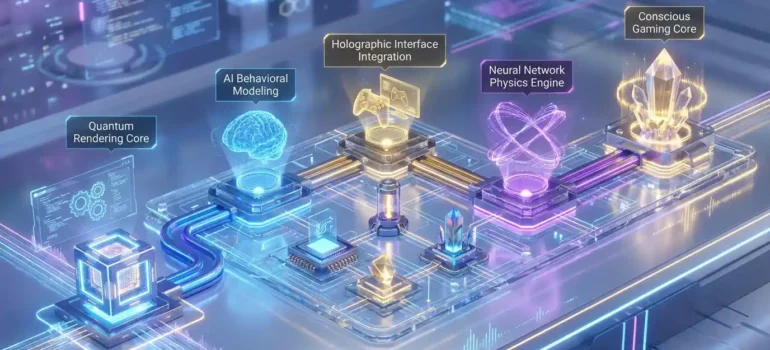
2026 iGaming R&D Roadmap: The Next Frontier in Game Engine Innovation
As we cross the threshold into 2026, the iGaming industry is undergoing a technical renaissance. The days of simple Flash-to-HTML5 migrations are long gone. Today, the battle for market share is won in the Research and Development (R&D) labs. At the heart of this transformation is the Game Engine. No longer just a framework for spinning reels, the modern iGaming engine is a complex ecosystem of real-time 3D rendering, AI-driven mathematics, and hyper-scalable cloud architecture.
This article outlines the 2026 iGaming R&D roadmap, focusing on the innovations that will define the next decade of digital entertainment.
The State of iGaming R&D in 2026
R&D in the iGaming sector has shifted from “Content Production” to “Platform Innovation.” While new game titles are still important, the *capability* of the platform to deliver those titles faster, more securely, and with higher fidelity is the real priority.
The Shift to “Engine-Centric” Development
In the past, each game was often built as a semi-bespoke project. In 2026, the focus is on building a robust, modular future of iGaming engine that can power hundreds of diverse titles with minimal per-game coding. This “Engine-Centric” approach allows for massive scalability and consistency.
Engine Innovation: Beyond the Grid
The most visible change in 2026 is the departure from traditional “grid-based” slot designs.
1. From 2D to Real-Time 3D
Modern game engines (leveraging WebGL 3.0 and WebGPU) now support full 3D environments within the mobile browser. This allows for cinematic camera angles, dynamic lighting, and a level of immersion previously reserved for AAA console games.
2. Physics-Based Game Mechanics
Why should a symbol just click into place? With physics-driven engines, symbols can bounce, collide, and interact with the environment. This opens the door to “Skill-Based” elements where the player’s timing or strategy can influence the visual outcome (while the underlying RNG ensures regulatory compliance).
3. Generative AI in Asset Production
R&D teams are increasingly using Generative AI to accelerate the creative process. Instead of artists spending weeks on background variations, AI can generate thousands of unique, high-quality assets in minutes. This allows for:
– Daily Content Refreshes: Updating game themes based on current events or holidays.
– Personalized Assets: Showing a player backgrounds that match their geographic location or personal taste.
The “Plug-and-Play” Platform Architecture
Innovation isn’t just about graphics; it’s about the “plumbing” of the platform.
Modular “Feature Packs”
The 2026 R&D roadmap emphasizes modularity. Want to add a “Bonus Buy” feature or a “Progressive Jackpot” to a game? Instead of writing new code, developers “plug in” a pre-validated module. This reduces the risk of bugs and speeds up the time-to-market.
Universal API Integration
A core R&D goal is creating a “Universal API” that allows games to be deployed across any operator platform-whether it’s a traditional web casino, a VR headset, or a social messaging app-without modification.
Market Data: iGaming R&D Investment Trends
Where is the money going? The following data represents the allocation of R&D budgets among top-tier iGaming B2B providers in 2026.
| R&D Focus Area | Budget Allocation (%) | Key Objective |
| :— | :— | :— |
| Game Engine Performance | 35% | 4K/60FPS on Mobile, WebGPU adoption |
| Artificial Intelligence | 25% | Generative assets, predictive math models |
| Cloud & Edge Infrastructure | 20% | Global sub-50ms latency, serverless scaling |
| Regulatory Tech (RegTech) | 15% | Automated compliance, real-time auditing |
| Web3 & Decentralization | 5% | Blockchain RNG, crypto-native payment rails |
The heavy investment in “Engine Performance” and “AI” confirms that technical superiority is the primary goal for 2026.
Preparing for the Next Decade: Quantum and Beyond
Forward-thinking R&D teams are already looking past 2026 toward the technologies that will dominate the 2030s.
Quantum Random Number Generators (QRNG)
As traditional computing power increases, the security of standard RNGs may eventually be challenged. QRNGs, which use quantum physics to generate truly random numbers, represent the ultimate in fair play and security.
Sustainable and “Green” Hosting
R&D is also focusing on the environmental impact of iGaming. “Green Hosting” initiatives aim to optimize code to require less CPU power, thereby reducing the carbon footprint of global server farms. Efficient code isn’t just fast; it’s sustainable.
Sustainable R&D: The “Lean” Approach
The most successful companies in 2026 are those that have mastered “Lean R&D.” This involves:
– Rapid Prototyping: Testing a new game mechanic with a small player group before full production.
– A/B Testing Everything: Using real-time data to decide between two different bonus feature designs.
– Continuous Deployment: Updating platform features daily rather than in monthly “big bang” releases.
Conclusion
The 2026 iGaming R&D roadmap is a journey toward more immersive, more efficient, and more intelligent gaming experiences. By focusing on engine innovation, AI integration, and modular architecture, platform providers can navigate the complexities of a rapidly changing market. For those who can stay ahead of the curve, the rewards are immense.
At DYG Games, our R&D innovation lab is dedicated to pushing these boundaries every day. Join us as we build the future of iGaming together.
FAQ: iGaming Engine Innovation
Q1: Is the traditional “Slot” dead?
Not at all. The *format* remains popular, but the *technology* under the hood is changing. Players still love 5-reel slots, but they now expect them to look like movies and behave like video games.
Q2: How does AI help with game math?
AI can run millions of simulated spins in seconds to “stress test” a new math model. This ensures that the game’s Return to Player (RTP) and volatility are exactly as intended before it ever reaches a real player.
Q3: Why is WebGPU a big deal?
WebGPU is the successor to WebGL. It provides much lower-level access to the device’s GPU, allowing for far more complex graphics and faster computations directly in the browser. It is the key to console-quality iGaming on mobile.
Q4: Can small developers compete with these R&D budgets?
Yes, by using modular “Platform-as-a-Service” (PaaS) solutions. Small developers can rent access to high-end engines and focus their limited R&D budget on unique creative concepts rather than infrastructure.
Q5: What is the biggest risk to these R&D roadmaps?
Regulation. If a new technology (like certain types of AI-driven volatility) is banned by regulators, R&D teams must be agile enough to pivot their strategy immediately.
Meta Title: 2026 iGaming R&D Roadmap: Engine Innovation & AI Trends
Meta Description: Explore the future of iGaming technology. Learn about 3D game engines, generative AI in gaming, and the R&D strategies driving the 2026 iGaming renaissance.
Tags: iGaming R&D, Game Engine, AI in Gaming, B2B iGaming, Future Trends, WebGPU, 2026 Trends